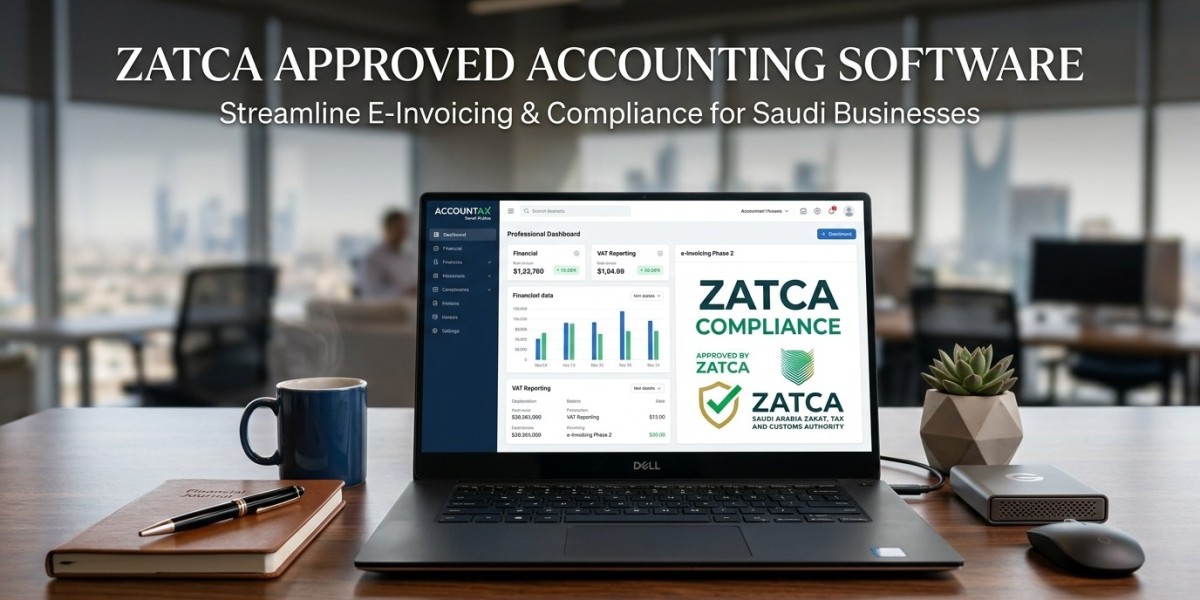

Managing business finances requires accurate records, organized transactions, timely invoices, and proper tax reporting. ZATCA Approved Accounting Software can help businesses in Saudi Arabia manage accounting activities while supporting electronic invoicing and applicable tax requirements. Instead of maintaining financial information across spreadsheets and disconnected tools, businesses can use a centralized accounting platform to record transactions, manage invoices, monitor VAT, and keep financial information organized. For companies that want to simplify daily accounting work, the right software can also reduce repetitive tasks and improve visibility into financial operations.
What Is ZATCA Approved Accounting Software
ZATCA Approved Accounting Software refers to accounting software designed to support businesses operating under the requirements of the Zakat, Tax and Customs Authority.
For businesses in Saudi Arabia, accounting software may need to work with electronic invoicing requirements and other applicable tax processes. A suitable system can help organizations manage accounting records while supporting the technical and operational requirements associated with e invoicing.
Depending on the platform, accounting software may provide features such as
- Sales and purchase management
- General ledger management
- Accounts receivable
- Accounts payable
- VAT management
- Electronic invoicing
- Expense tracking
- Financial reporting
- Customer and supplier records
- Payment tracking
- Tax related records
Businesses should always verify that a specific software solution and its configuration meet the requirements applicable to their own operations.
Why Modern Business Accounting Needs Digital Tools
Manual accounting processes can become difficult as a business grows.
A small company might initially manage invoices and expenses with spreadsheets. However, when transaction volumes increase, employees have more records to maintain and more opportunities for errors can appear.
Modern business accounting relies increasingly on digital systems to organize financial information.
A digital accounting platform can help businesses record transactions as they happen and connect different financial activities.
For example, a sales invoice can be connected with customer information, payment status, tax information, and financial records.
This reduces the need to enter the same information repeatedly.
Supporting ZATCA E Invoicing
Electronic invoicing is an important consideration for businesses operating in Saudi Arabia.
ZATCA e invoicing requirements involve the electronic generation and processing of invoices according to applicable rules.
Businesses need appropriate systems and processes to create invoices in the required electronic format and handle the relevant reporting or integration requirements.
Accounting software with e invoicing capabilities can bring invoice creation into the same environment used for financial management.
This can make it easier for employees to create, record, and track invoices while maintaining connected accounting records.
How Electronic Invoicing Can Improve Accounting Workflows
Traditional paper or manually prepared invoices can require several separate steps.
An employee may create an invoice, save a copy, send it to the customer, enter the transaction into an accounting spreadsheet, and later update the payment status.
A digital system can connect many of these activities.
A typical workflow may look like this
- Customer information is selected.
- Products or services are added.
- Applicable tax information is calculated according to configured rules.
- The electronic invoice is generated.
- The invoice is stored in the accounting system.
- The invoice is shared through the available digital process.
- Payment status is updated.
- Financial reports reflect the transaction.
The exact workflow depends on the software and the business setup.
ZATCA Compliant Accounting Software
Businesses searching for ZATCA compliant accounting software should look beyond a simple accounting feature list.
The software should be evaluated based on its ability to support the applicable ZATCA requirements, including electronic invoicing requirements relevant to the business.
Businesses should also check whether the software provider maintains the solution as requirements change.
A platform that supports accounting but does not properly handle required e invoicing processes may create additional work for the finance team.
Before selecting a solution, businesses should confirm the provider's current compliance claims and determine whether the system is appropriate for their specific invoicing requirements.
VAT Accounting Software
VAT is another important area of business accounting in Saudi Arabia.
VAT accounting software can help businesses record transactions and manage VAT related information within their accounting workflow.
Depending on the system, businesses may be able to manage
- Taxable sales
- Purchases
- VAT amounts
- Customer invoices
- Supplier invoices
- Tax records
- VAT reports
Automating calculations can reduce repetitive manual work, but businesses should still review their tax configurations carefully.
Incorrect tax settings can affect invoices and financial reports, so the software should be configured according to the organization's actual tax requirements.
Managing Sales And Purchase Transactions
Accounting software can bring sales and purchasing activities into a centralized financial system.
When a sale is recorded, the system can update the relevant customer and financial records.
Similarly, supplier purchases can be recorded and connected with accounts payable.
This gives finance teams a clearer view of money coming into and going out of the business.
For growing businesses, having this information in one place can make daily accounting work more manageable.
Managing Accounts Receivable
Businesses need to know which customers have paid and which invoices are still outstanding.
A digital accounting platform can help finance teams monitor accounts receivable.
Employees can review invoice dates, payment status, outstanding amounts, and customer information.
Some platforms may also provide reminders or automated workflows for overdue invoices.
This can help businesses maintain better control over incoming payments.
For example, if several invoices remain unpaid beyond their expected payment dates, the finance team can identify them and follow up with customers.
Managing Accounts Payable
The same principle applies to supplier payments.
Businesses often work with multiple suppliers and receive invoices at different times.
Accounting software can organize supplier invoices and payment information.
Finance teams can see what is due and maintain records of completed payments.
This can help businesses plan cash flow and reduce the chance of missing important supplier payments.
Digital Accounting Software And Financial Records
Digital accounting software can reduce dependence on paper based financial records.
Financial information can be stored electronically and organized according to the business's accounting structure.
This can make it easier to search for transactions and review historical information.
For example, a finance employee may need to find an invoice from several months earlier.
Instead of searching through physical files, they can use the software's search and reporting features.
Digital records can also make it easier to share relevant information between authorized finance team members.
Financial Reporting
Accounting is not only about recording transactions.
Business owners and managers also need financial information to make decisions.
Accounting software can generate reports that help management review the company's financial position.
Common reports may include
- Profit and loss statements
- Balance sheets
- Cash flow information
- Sales reports
- Expense reports
- Accounts receivable reports
- Accounts payable reports
- VAT related reports
The exact reports available depend on the accounting platform.
When financial information is updated consistently, these reports can provide a more useful picture of business performance.
Reducing Manual Accounting Tasks
Finance teams often spend significant time on repetitive activities.
These can include entering invoice details, updating payment records, calculating amounts, preparing reports, and organizing financial documents.
Automation can reduce some of this repetitive work.
For example, once a transaction is recorded, the system can update connected financial records automatically.
This allows employees to spend more time reviewing information and handling tasks that require judgment.
Automation should still be monitored because incorrect configurations or inaccurate source data can produce incorrect results.
Improving Financial Accuracy
Human errors can occur when employees repeatedly enter the same information into different systems.
For example, an invoice amount might be entered incorrectly into a spreadsheet even though the original invoice contains the correct figure.
A centralized accounting system can reduce duplicate data entry by connecting related processes.
However, software does not eliminate the need for financial controls.
Businesses should establish appropriate approval procedures, review financial records, and reconcile accounts regularly.
Technology works best when it is combined with sound accounting practices.
Integration With Business Systems
A growing company may use several systems for its daily operations.
For example, a business could have separate platforms for sales, inventory, payments, customer management, and accounting.
Integrating these systems can reduce the need to manually transfer information between them.
Depending on the accounting solution, it may be possible to integrate with
- POS systems
- E commerce platforms
- Inventory systems
- Payment platforms
- Customer relationship management systems
- Payroll systems
- Banking services
Integration requirements should be reviewed before selecting software because every business has a different technology environment.
Security And Financial Data
Financial information is sensitive business information.
When choosing accounting software, businesses should consider how the platform protects financial records and controls access.
Important considerations may include
- User permissions
- Authentication
- Data backups
- Access logs
- Data encryption
- Account controls
- Backup and recovery processes
Employees should only have access to the financial information they need for their roles.
For example, an employee responsible for creating invoices may not need permission to modify important accounting configurations.
Choosing ZATCA Approved Accounting Software
Before selecting ZATCA Approved Accounting Software, businesses should evaluate both accounting functionality and applicable compliance requirements.
Consider questions such as
- Does the system support electronic invoicing?
- Does it support applicable ZATCA requirements?
- Can it manage VAT related transactions?
- Can it generate financial reports?
- Does it support multiple users?
- Can it integrate with existing business systems?
- Can it handle the company's transaction volume?
- Are customer and supplier records easy to manage?
- Does the provider provide technical support?
- How are software updates handled?
- What security controls are available?
It is also useful to request a demonstration before making a decision.
A demonstration can help finance teams see how invoices, VAT records, payments, reports, and other accounting tasks are handled.
Implementing Accounting Software In A Business
Software implementation should be planned carefully.
Start by reviewing existing accounting processes and identifying areas where employees spend the most manual effort.
Next, organize customer, supplier, product, tax, and financial information that needs to be transferred into the new system.
The accounting team should receive training before the platform becomes the main system for daily operations.
It is also important to test invoices, tax calculations, reports, integrations, and other important workflows before going live.
After implementation, businesses should continue reviewing the system to make sure financial information remains accurate and processes continue to meet applicable requirements.
The Role Of Accounting Teams
Even with advanced automation, accounting professionals remain important.
Software can calculate, organize, store, and report financial information, but people are responsible for reviewing the results and making financial decisions.
Accounting teams should monitor transactions, reconcile accounts, review tax information, and investigate unusual records.
They should also keep up with relevant regulatory requirements and make sure the company's accounting procedures are properly maintained.
The best results come when software supports professional accounting practices rather than attempting to replace them.
Final Thoughts On ZATCA Approved Accounting Software
ZATCA Approved Accounting Software can provide businesses with a centralized way to manage accounting activities, electronic invoicing, VAT records, customer transactions, supplier payments, and financial reporting.
For businesses in Saudi Arabia, choosing software that supports applicable ZATCA requirements can help create a more organized approach to electronic invoicing and tax related accounting processes.
At the same time, businesses should not select software based only on the word "approved" or on a list of features. You should verify the provider's current compliance claims, understand the specific requirements that apply to your business, and make sure the software fits your accounting workflow.
With suitable digital accounting software, clear financial procedures, trained employees, and regular reviews, businesses can create a more reliable accounting environment that supports everyday financial management and future business growth.