
Home-based diagnostic services have become far more common in Bangalore over the last few years, and echocardiography is now among the tests available at your doorstep. But the idea of bringing a cardiac ultrasound machine to your living room naturally raises questions. Is the quality comparable? Is it safe? Who performs the test? And when does it genuinely make sense versus when should you go to a facility?
If you've been considering an echo test at home in Bangalore for yourself or a family member, here's an honest breakdown of what to expect, who it's suitable for, and what to verify before you book.
What an Echocardiogram Actually Involves
An echocardiogram is an ultrasound scan of the heart. Unlike an ECG, which measures electrical activity, an echo uses sound waves to create real-time moving images of the heart's chambers, valves, and surrounding structures. It shows how blood flows through the heart and how efficiently the heart is pumping.
The test is used to evaluate:
Heart failure and reduced pumping function
Valve conditions such as mitral regurgitation or aortic stenosis
Pericardial effusion (fluid around the heart)
Cardiomyopathy (disease of the heart muscle)
Congenital heart abnormalities
Post-heart attack structural assessment
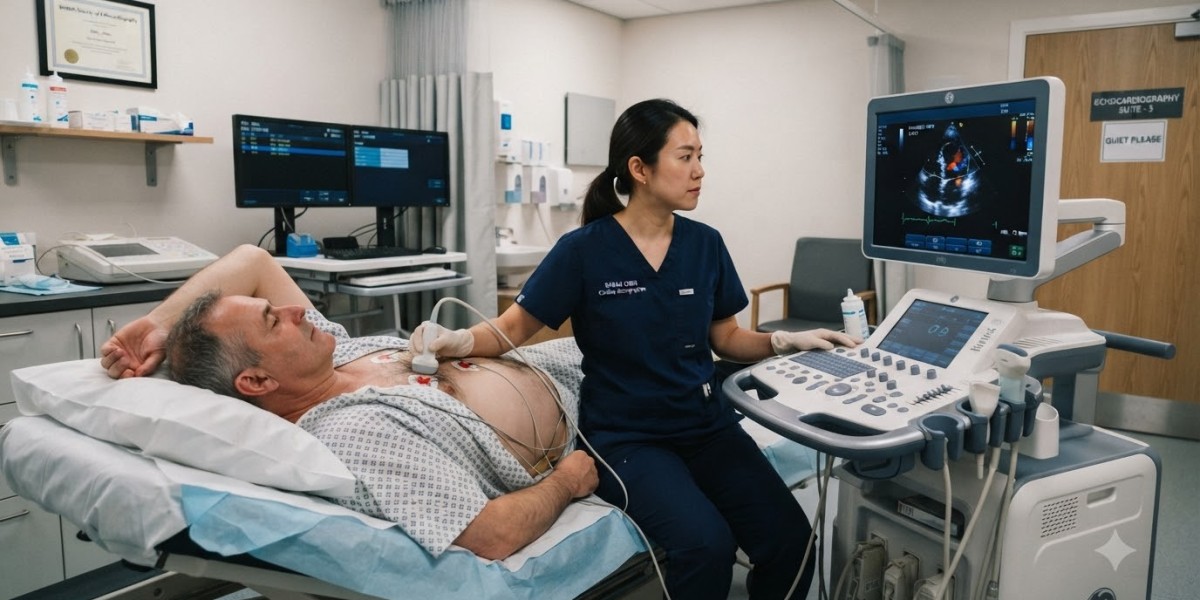
A standard transthoracic echocardiogram (TTE) involves a technician placing a transducer on the chest and recording images from multiple angles. This is the type available for home-based services.
When a Home Echo Test Makes Genuine Sense
A home visit echocardiogram is not suitable for every patient or every clinical situation. But there are specific circumstances where it is genuinely the more practical option:
Limited Mobility Patients
Elderly patients, those recovering from orthopaedic surgery, or individuals with severe heart failure often find travel to a diagnostic centre difficult or physically taxing. For them, a home echo service reduces risk and provides necessary diagnostic information without the burden of transport.
Post-Hospitalisation Monitoring
Patients recently discharged from hospital may need a follow-up echo to track recovery progress. A home visit allows this without requiring the patient to return to a hospital environment unnecessarily.
Chronic Cardiac Condition Management
Patients with established heart conditions who need periodic echocardiography for ongoing monitoring — rather than urgent investigation — are well suited to a home-based service.
Palliative or Bedridden Patients
For patients receiving end-of-life care, a home echo service provides diagnostic support without requiring hospitalisation.
If you are experiencing acute chest pain, breathlessness of sudden onset, or any emergency cardiac symptom, this is not the time for a home visit service. Go to a hospital emergency department immediately.
What Good Home Echo Services in Bangalore Should Provide
Not all home diagnostic services are equal. Before booking, verify the following:
Qualified Cardiac Sonographer
The person performing the scan must be a trained cardiac sonographer — not a general ultrasound technician. Echocardiography requires specific training because image acquisition is highly operator-dependent. The quality of the images directly determines what the reporting cardiologist can see.
Portable Equipment Quality
Portable echocardiography machines have improved significantly. Modern portable echo machines used by reputable services produce image quality comparable to fixed equipment in many clinical scenarios. Ask the provider specifically about the machine they use for home visits.
Cardiologist Reporting
As with ECG, the recording must be reviewed and reported by a qualified cardiologist. This is not optional. Confirm before booking that a cardiologist — not a general radiologist — will interpret your echo.
Report Turnaround
For a home visit, the images are recorded and then sent digitally to the reporting cardiologist. Confirm how quickly you will receive the written report after the visit.
What to Prepare at Home Before the Visit
Making simple preparations ensures the visit goes smoothly and the images are acquired efficiently:
Choose a room that is quiet and has reasonable lighting
Have a bed or reclining chair available where the patient can lie flat and then turn slightly to the left side
The patient should wear loose, comfortable clothing that allows easy access to the chest area
No fasting is required for a standard transthoracic echo
Have all previous cardiac reports, medications list, and the referring doctor's instructions ready for the technician
Inform the service provider in advance of any mobility limitations so they can bring appropriate equipment
Limitations to Be Aware Of
Home-based echocardiography has genuine advantages, but it also has limitations that are worth understanding:
Acoustic window challenges: In some patients — particularly those who are obese, have emphysema, or have had previous chest surgery — obtaining adequate echocardiographic images can be difficult even with full hospital equipment. This challenge is the same or greater with portable equipment.
No real-time cardiologist presence: In a hospital echo lab, the cardiologist can often be consulted during the scan. With home services, the technician acquires images independently and sends them for later reporting.
Emergency response: If the patient deteriorates during the visit, a home setting does not have the immediate emergency resources of a diagnostic centre or hospital.
Not suitable for stress echo or TOE: Stress echocardiography (echo combined with exercise or medication-induced stress) and transoesophageal echocardiography (TOE) require facility-based environments. These cannot be performed at home.
How the Report Reaches Your Cardiologist
After the home visit, the technician transfers the recorded echo data to a digital platform. The reporting cardiologist reviews the images and produces a written report, which is then delivered to you — typically via email or patient portal — and can be shared directly with your treating physician.
Some services coordinate directly with your cardiologist, which streamlines the referral loop considerably.
Frequently Asked Questions
Is the accuracy of a home echo test comparable to one done at a hospital?
For most standard clinical questions — ejection fraction, valve assessment, pericardial effusion — a home echo performed by a skilled sonographer using quality portable equipment is clinically reliable. However, for complex structural evaluations or when image quality is challenging, a facility-based echo with full equipment may be preferred.
How long does a home echo appointment take?
The actual scanning time is typically 30 to 45 minutes. With setup and documentation, the technician's total time at your home is usually around 60 minutes. Report turnaround depends on the service provider.
Does health insurance cover home echo services?
Coverage varies by insurer and policy. Many health insurance plans cover echocardiography when ordered by a doctor, but some may specify that it must be performed at an empanelled facility. Check with your insurer and confirm that the home service provider can supply the required documentation for claims.
Is the echo test safe for heart patients at home?
Yes. A standard transthoracic echocardiogram is completely safe and non-invasive. It uses sound waves with no radiation exposure. There is no risk associated with the test itself.
Can the echo test at home detect if a heart attack is imminent?
No diagnostic test can predict an imminent heart attack with certainty. An echocardiogram can identify existing structural damage, reduced function, and valve problems that increase cardiac risk, but it is not a predictor of acute events. If you have symptoms of chest pain or pressure, seek emergency care immediately.
An echo test at home in Bangalore can be an excellent solution when the right patient, the right clinical question, and the right provider come together. The key is not to compromise on the quality of the sonographer or the reporting cardiologist simply because the setting is more convenient. Home-based care works best when the clinical standards travel with the technician.