
When a doctor hands you an MRI referral, the first instinct is to search for the nearest available option and book the first appointment you find. That approach often leads to longer waiting times, unexpected costs, and occasionally, poor-quality imaging that requires a repeat scan. Understanding what actually separates a reliable MRI facility from a mediocre one can save you both money and unnecessary stress.
If you are actively looking for MRI scan centres near me, it helps to know that proximity alone should never be your only filter. Ecotown Diagnostics offers well-equipped MRI scan centres near me that combine diagnostic accuracy with reasonable turnaround times — a combination that genuinely matters when results are time-sensitive.
Why People End Up Choosing the Wrong MRI Centre
Most people evaluate MRI centres the same way they choose a restaurant — by distance and reviews alone. However, diagnostic imaging involves far more variables than general healthcare services.
The machine itself matters. An older 0.5 Tesla MRI produces very different image clarity compared to a 1.5 Tesla or 3 Tesla unit. Centres that do not clearly mention their equipment specifications on their websites or at reception are worth questioning.
Radiologist expertise is equally important. An MRI produces images, but it is the radiologist's interpretation that becomes your report. An underqualified radiologist reading a high-quality scan can still produce a misleading report.
What to Actually Look For in an MRI Scan Centre
Machine Strength and Technology
Tesla rating directly affects scan resolution. For most neurological, musculoskeletal, and abdominal scans, 1.5 Tesla is the clinical standard. Specialised brain or spinal imaging may benefit from 3 Tesla machines. Always ask what equipment a centre uses before booking.
Accreditation and Certification
NABL accreditation is a strong indicator that a diagnostic centre follows standardised quality protocols. Accredited centres undergo regular audits of their equipment calibration, staff qualifications, and reporting processes. This is not a minor detail — it directly affects the reliability of your results.
Radiologist Qualifications
Ask whether the report will be signed by a qualified radiologist or a general physician. A DNB or MD in Radiology with experience in the relevant scan type — neuro, musculoskeletal, abdominal — is what you should expect.
Report Turnaround Time
Some centres deliver same-day reports. Others take 24 to 48 hours. If you are seeing a specialist the next morning, turnaround time becomes critical. Always confirm this before booking, not after.
Patient Comfort and Claustrophobia Management
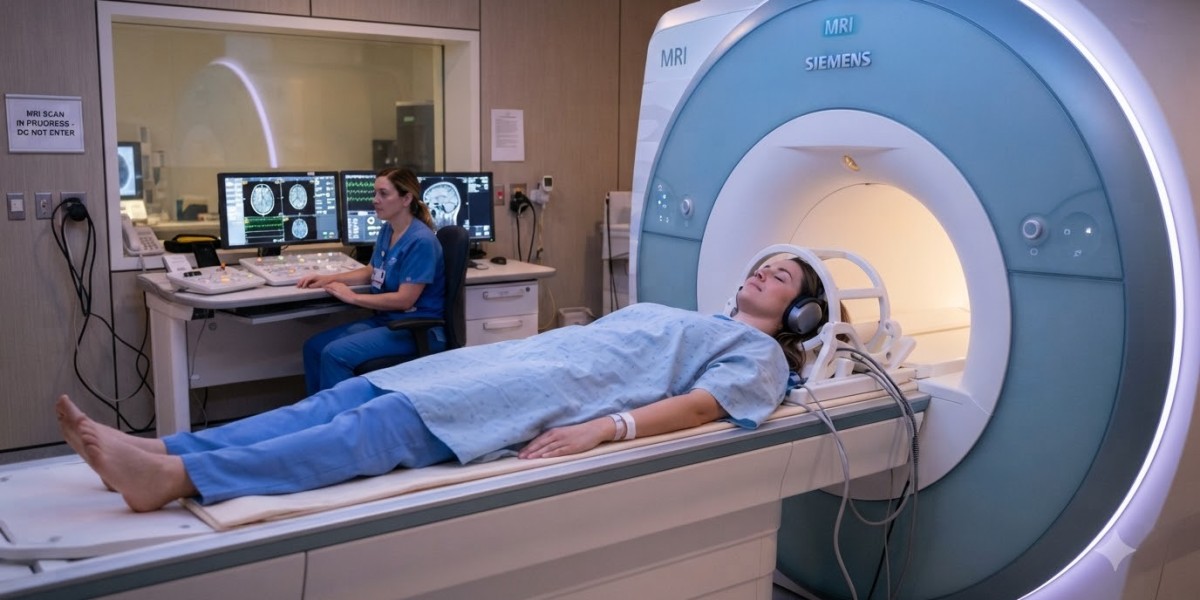
Standard MRI machines are enclosed tubes. Many patients experience anxiety or claustrophobia during the scan. A good centre will explain the process beforehand, offer ear protection, and have protocols for anxious patients. Some facilities also have wide-bore or open MRI options for those with severe claustrophobia.
Common Types of MRI Scans and Why They Are Ordered
Understanding why your doctor has recommended a specific MRI type helps you ask better questions when choosing a centre.
Brain MRI — Used to detect tumours, strokes, multiple sclerosis, and structural abnormalities
Spine MRI — Ordered for disc herniation, nerve compression, or spinal cord issues
Knee/Joint MRI — Assesses ligament tears, cartilage damage, and joint inflammation
Abdominal MRI — Evaluates organs such as the liver, kidneys, and pancreas
Cardiac MRI — Specialised imaging for heart muscle and function
Not every centre performs all types with equal proficiency. If you need a cardiac or functional MRI, confirm that the centre has the protocol and expertise for that specific scan.
What Happens During an MRI Scan
Many first-time patients arrive anxious because they do not know what to expect. Here is a straightforward breakdown:
You will be asked to remove all metal objects — jewellery, belts, glasses, and hearing aids
You will lie on a motorised table that slides into the scanner
The machine produces loud knocking or banging sounds — this is normal
Depending on the scan type, the procedure takes 20 to 60 minutes
For some scans, a contrast agent (gadolinium) may be injected through a vein to improve image visibility
You will be asked to remain still throughout to avoid motion blur in the images
There is no radiation involved in MRI. Unlike CT scans or X-rays, MRI uses magnetic fields and radio waves. This makes it particularly suitable for repeated scans and for children.
Factors That Affect MRI Pricing
Pricing varies significantly across centres in any city. Here is what actually drives the difference:
Scan type — A brain MRI without contrast costs differently from one with contrast
Machine quality — Higher Tesla machines cost more to operate
Radiologist fees — Senior radiologists may charge more but provide more accurate reports
Centre location — Premium locations carry higher overhead
Report format — Some centres charge extra for CD or digital image copies
Always request an itemised breakdown when comparing prices. A cheap MRI with a poor-quality report may ultimately cost more if your specialist requires a repeat scan from a different facility.
Questions to Ask Before Booking
Before confirming an appointment at any facility you find when searching for MRI scan centres near me, ask these directly:
What is the Tesla rating of your MRI machine?
Is your centre NABL accredited?
Who reads and signs the MRI reports?
How long before I receive my report?
Do you offer contrast MRI and what is the additional cost?
Is there parking or public transport access?
Can I reschedule if needed?
A centre that is reluctant to answer these questions clearly is worth approaching with caution.
The Difference Between a Walk-In and an Appointment-Based Centre
Walk-in centres can be convenient, but they often mean longer wait times and rushed scanning slots. Appointment-based centres allow you to choose a time that suits you, reduce wait time on arrival, and give the radiologist adequate time for your specific scan type.
For planned investigations, booking an appointment is always the better approach. For urgent referrals, check whether the centre accommodates same-day or next-day slots.
Frequently Asked Questions
Do I need a doctor's referral to get an MRI scan?
Most diagnostic centres will ask for a referral letter from your treating physician. This ensures the correct scan type is ordered for your condition. Some centres do allow self-referral for specific scans, but it is always better to have a doctor guide the type and region being scanned.
Can I eat before an MRI scan?
For most MRI scans, eating beforehand is not restricted. However, abdominal or pelvic MRI scans may require fasting for a few hours. Your centre will give you specific preparation instructions when you book.
Is MRI safe for everyone?
MRI is generally very safe. However, individuals with certain metal implants such as pacemakers, cochlear implants, or older aneurysm clips may not be eligible. Always disclose your full medical history before the scan.
How do I know if my report is accurate?
Accurate reports come from a combination of high-quality imaging equipment and experienced radiologist interpretation. NABL-accredited centres that employ qualified radiologists with relevant specialisation are your strongest assurance of accuracy.
What if I feel claustrophobic during the scan?
Inform the centre when booking. They can advise on sedation options or open MRI availability. During the scan, you will have a communication button to alert the technician if you need to stop.
Choosing where to get your MRI done is not a decision to rush. The centre you select will directly affect the quality of your diagnosis and the next steps your doctor recommends. Take a few minutes to ask the right questions, compare equipment and accreditation, and book a centre that prioritises accuracy alongside convenience.