
INTRODUCTION
Modern neonatal intensive care depends on carefully planned infrastructure, specialized medical equipment, reliable utilities, and effective technical support. Hospitals evaluating NICU Manufacturers In India should consider how proposed solutions address the complete needs of a neonatal intensive-care environment. NHSRC maintains dedicated technical specifications for equipment used in Special Neonatal Care Units and neonatal and pediatric intensive-care units, helping healthcare facilities assess equipment according to defined technical requirements.
Understanding Modern NICU Requirements
The first step is to identify the hospital's expected neonatal patient load, level of care, bed capacity, available space, staffing, and clinical services. These factors influence the type and quantity of equipment required and help determine the infrastructure needed around each patient.
A well-planned NICU should allow healthcare professionals to access patients and equipment efficiently while maintaining an organized clinical workflow.
Providing Specialized Neonatal Equipment
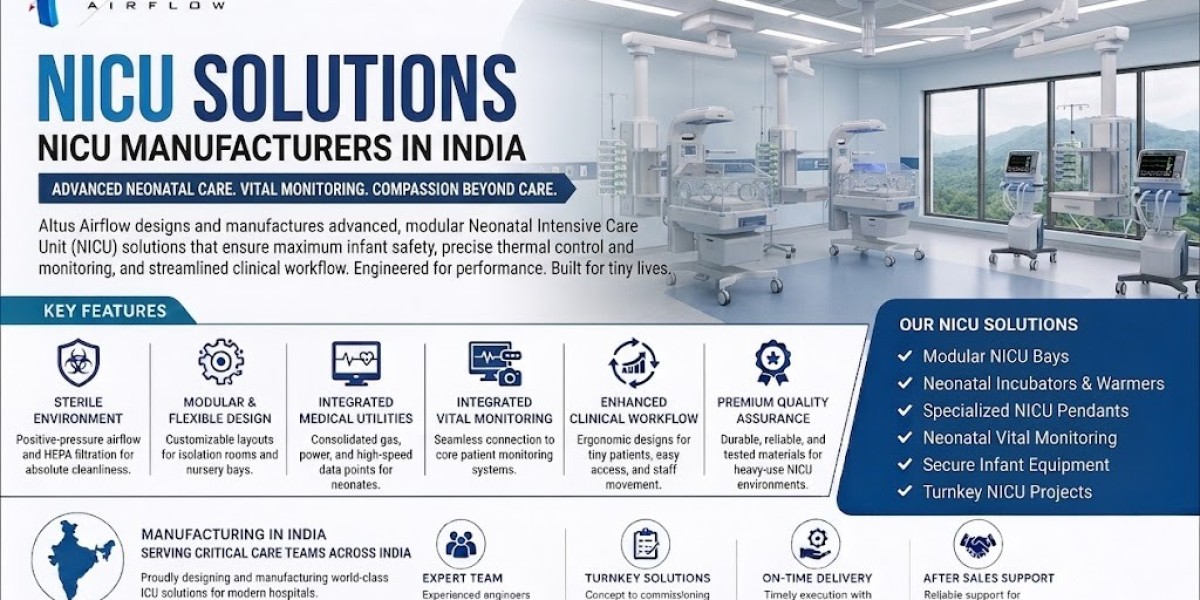
Neonatal patients require equipment designed for their particular clinical requirements. Depending on the level of care, a NICU may require neonatal ventilators, CPAP systems, patient monitors, syringe and infusion pumps, radiant warmers, incubators, phototherapy equipment, suction systems, and transport equipment. Government technical resources specifically include equipment specifications for neonatal and pediatric intensive-care settings.
Manufacturers can support hospitals by providing equipment that matches the planned clinical applications and by supplying appropriate technical documentation and accessories.
Supporting Ventilation and Monitoring
Respiratory support and continuous monitoring are important components of neonatal intensive care. Hospitals should examine ventilation capabilities, monitoring parameters, power requirements, accessories, and other technical specifications when evaluating proposed equipment.
Using dedicated technical specifications can help clinical and biomedical teams compare equipment according to its intended application rather than relying only on general product descriptions.
Integrating Infrastructure With Equipment
Medical equipment needs suitable infrastructure to operate effectively. Hospitals should assess electrical requirements, backup power, medical gases, suction, equipment placement, lighting, storage, and available working space.
A coordinated approach to infrastructure and equipment can help reduce installation difficulties and support more efficient use of the NICU environment.
Focusing on Installation and Training
A complete neonatal-care solution should include appropriate installation, commissioning, documentation, and user training. Clinical and technical staff should understand equipment operation, routine checks, and basic troubleshooting procedures.
Hospitals can review installation requirements, technical manuals, training provisions, warranty conditions, and service arrangements before finalizing procurement.
Maintaining Equipment Reliability
Maintenance is an important part of managing medical equipment in critical-care environments. Hospitals should assess preventive maintenance, corrective servicing, calibration, testing, technical assistance, and spare-parts availability.
NHSRC's Biomedical Equipment Management and Maintenance Program specifically addresses equipment maintenance, calibration, testing, and equipment uptime.
Reliable maintenance planning can help hospitals manage equipment throughout its operational life rather than treating service support as a post-installation concern.
Planning for Future NICU Development
Neonatal services may expand as hospitals add beds, introduce new technologies, or develop additional clinical capabilities. Infrastructure should therefore provide reasonable flexibility for equipment upgrades and future modifications.
Hospitals can discuss available space, utility capacity, compatibility, and expansion possibilities with manufacturers during the initial planning stage.
CONCLUSION
Choosing NICU Manufacturers In India involves evaluating specialized equipment, technical specifications, infrastructure compatibility, installation, training, maintenance, and future adaptability. By assessing these factors together, hospitals can develop neonatal intensive-care environments that are appropriately equipped and supported for their intended clinical requirements. NHSRC's technical and equipment-management resources provide useful references for structured evaluation and ongoing equipment management.
FAQs
1. What should hospitals consider when selecting a NICU solution?
Hospitals should evaluate clinical requirements, neonatal equipment, technical specifications, infrastructure, installation, staff training, maintenance, technical support, and future expansion needs.
2. What equipment is commonly used in a NICU?
Depending on the level of care, equipment may include neonatal ventilators, CPAP systems, incubators, radiant warmers, phototherapy units, patient monitors, syringe pumps, infusion pumps, suction systems, and transport equipment.
3. Why are technical specifications important?
Technical specifications help clinical and biomedical teams compare equipment according to performance requirements, intended use, safety considerations, installation needs, and supporting documentation.
4. Why is maintenance important for neonatal equipment?
Preventive maintenance, calibration, testing, and timely servicing are important components of structured biomedical equipment management and can support equipment availability and reliability.
5. Should hospitals consider future NICU expansion?
Yes. Hospitals can review available space, utility capacity, equipment compatibility, and infrastructure flexibility during initial planning to accommodate changing neonatal-care requirements.
Read Our Previous Blog-----------> Which ICU Manufacturers In India Offer Modern Solutions?