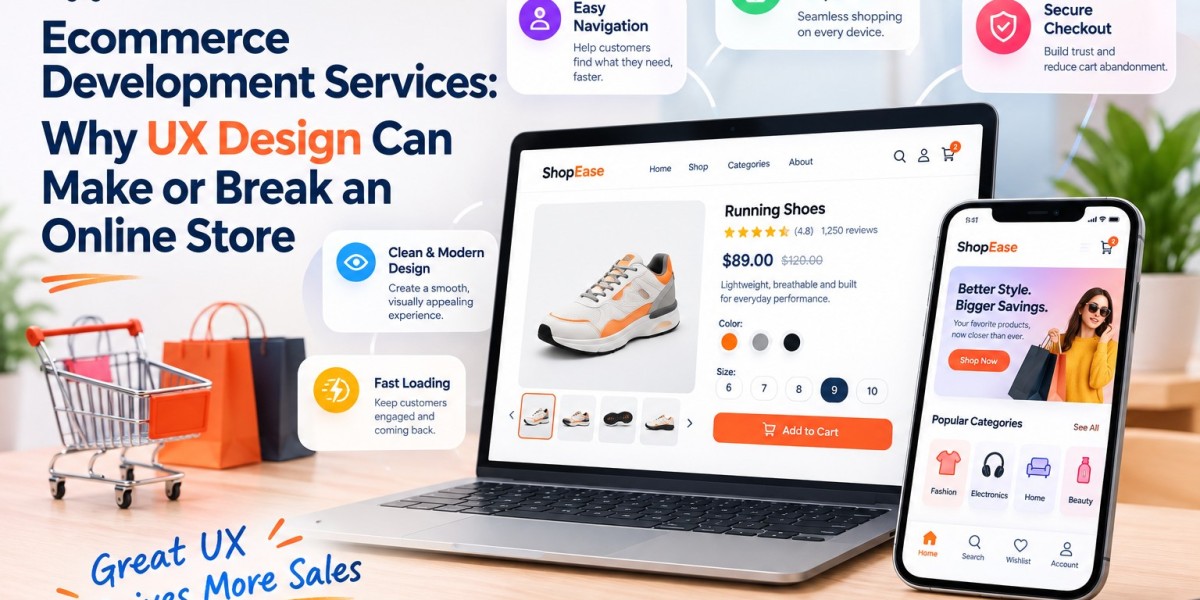

A customer finds a product they like, opens the store, checks the price, and adds it to the cart. Then something feels awkward. The product details are unclear. The checkout asks for too much information. The page is difficult to use on a phone.
The customer leaves.
The product may have been exactly what they wanted. The problem was the experience.
That is why UX design services deserve serious attention when businesses invest in ecommerce development services. Building an online store is not simply about adding products to a website and connecting a payment gateway. It is about creating a buying journey that feels straightforward from the first click to the final confirmation.
What Makes Ecommerce Development More Than Website Building?
An ecommerce website has several moving parts working together.
There is the storefront customers see, the product catalogue behind it, inventory information, payment processing, shipping options, customer accounts, order management, security, analytics, and often connections with other business systems.
A technically functional store can still be frustrating to use.
For example, imagine an online clothing store with thousands of products but poor filtering. A visitor looking for a particular size and colour may have to browse dozens of pages. The website works correctly, but the shopping experience does not.
Good ecommerce development considers both sides: the technology that powers the store and the experience that helps customers use it.
Why UX Design Services Matter in Ecommerce
UX design services focus on how people interact with a website and how easily they can accomplish what they came to do.
In ecommerce, that usually means helping customers:
Find products quickly
Understand product information
Compare options
Select variants
Add items to a cart
Complete checkout
Understand delivery information
Get help when something goes wrong
Think about the last time you abandoned an online purchase. It may not have been because you disliked the product. Perhaps shipping costs appeared unexpectedly, the checkout page was confusing, or the website required account creation before allowing payment.
These small moments create friction.
Good UX identifies those moments and reduces them.
Start With How People Shop, Not How the Website Is Organised
Businesses often structure websites according to their internal departments or product categories.
Customers do not necessarily think that way.
A retailer might organise products according to internal inventory systems, while shoppers may want to browse by occasion, problem, budget, material, size, or use case.
This distinction matters.
An effective ecommerce experience begins by understanding how customers search, compare, evaluate, and purchase.
For instance, someone buying running shoes may care about cushioning, terrain, fit, and running style more than the manufacturer's internal product category.
The website should make those decisions easier.
Product Pages Should Answer Questions
A product page is not just a place to display a photograph and price.
It needs to answer the questions that might prevent a customer from buying.
Depending on the product, visitors may want to know:
What is it made from?
What are its dimensions?
How does it fit?
What is included?
How does it compare with similar products?
When will it arrive?
Can it be returned?
Is it available in the required size or colour?
High-quality images help, but clear information matters just as much.
If customers repeatedly contact support to ask questions that could have been answered on the product page, that may indicate an opportunity to improve the experience.
Search and Navigation Can Quietly Influence Sales
A large ecommerce catalogue needs strong navigation.
Menus, filters, categories, search suggestions, sorting options, and breadcrumbs all help customers narrow their choices.
Consider a store selling home appliances. Someone may want a refrigerator under a particular budget, with a certain capacity and energy rating.
A useful filtering system can turn a catalogue of hundreds of products into a manageable shortlist.
That feels simple to the shopper.
Behind the scenes, it requires careful planning.
Checkout Should Not Feel Like a Test
Customers should not have to work hard to give you money.
A good checkout experience makes the necessary steps clear and removes unnecessary distractions.
Businesses should review questions such as:
Is guest checkout available where appropriate?
Are shipping charges clearly explained?
Are payment options easy to understand?
Can customers correct mistakes before submitting an order?
Is the form comfortable to use on mobile?
Are error messages helpful?
Does the checkout clearly show the final amount?
The goal is not to eliminate every field or create a one-click fantasy.
The goal is to make each required step understandable.
Mobile Ecommerce Requires Special Attention
Many customers browse products on their phones, sometimes while travelling, waiting, or multitasking.
A desktop layout simply shrunk onto a mobile screen may not provide a good experience.
Buttons need to be easy to tap. Product images should remain useful. Filters should be accessible without taking over the screen. Forms should be manageable with a small keyboard.
This is another area where UX thinking matters.
Mobile design is not just about making everything smaller. It is about deciding what deserves attention first.
Where Business Website Development Fits In
Ecommerce projects often overlap with broader business website development.
A company may need an online store alongside corporate pages, service information, resources, careers content, support documentation, or partner portals.
These areas need to feel like parts of the same organisation while serving different purposes.
For example, the ecommerce section may focus heavily on product discovery and purchasing, while the corporate section may explain the company, its expertise, and its broader services.
A thoughtful information architecture keeps both experiences understandable.
Choosing a Business Website Development Company
Selecting a business website development company should involve more than reviewing visual portfolios.
Ask how the team approaches usability, performance, security, integrations, content management, mobile experiences, and future changes.
A good development partner should also be willing to discuss the uncomfortable questions.
What happens when product information changes? How will inventory be managed? What happens if a payment fails? How easily can new categories be added? Who will maintain the website after launch?
Ecommerce websites are living systems.
They need room to evolve.
How Amigo Softtech Can Fit Into the Bigger Picture
For businesses exploring ecommerce or broader digital development, Amigo Softtech can be considered when the project requires a combination of website development, user experience, and digital strategy.
The technology should support the customer's journey rather than become the centre of attention.
That means thinking carefully about the relationship between design, content, functionality, performance, and business objectives.
A visually attractive store that is difficult to navigate is not a successful ecommerce experience.
Build for Customers, Then Build for Growth
The strongest ecommerce websites make purchasing feel natural.
Customers can discover products without unnecessary effort. They can understand what they are buying. They know what delivery will involve. They can complete checkout without confusion. And when something goes wrong, they can find help.
That is the real value of thoughtful UX design services.
Ecommerce development services provide the technical foundation, but user experience determines how comfortably customers can use that foundation.
When business website development combines solid technology with careful UX decisions, an online store becomes more than a digital catalogue. It becomes a useful place where people can browse, compare, decide, and buy with confidence.
And that is ultimately what a good ecommerce website should do: make the customer's next step feel obvious.