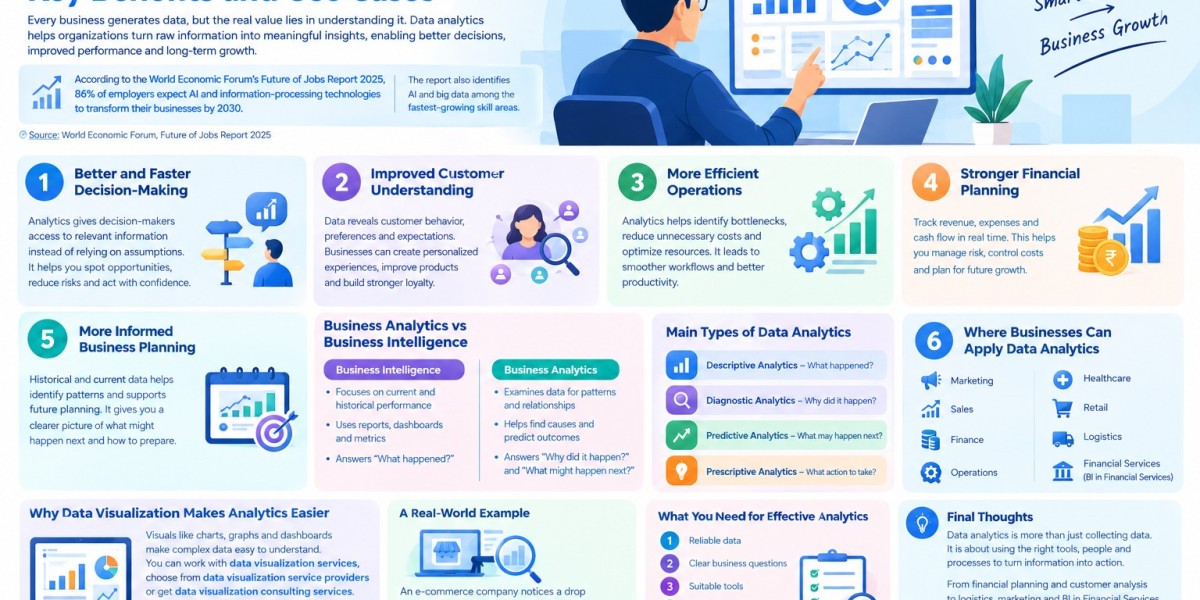

Every business generates data, from customer purchases and website visits to employee performance, financial transactions, and operational activity. The real challenge is not collecting this information. It is understanding what the data is saying and using those insights to make better business decisions.
The importance of this capability is becoming clearer as businesses adopt more digital technologies. According to the World Economic Forum's Future of Jobs Report 2025, 86% of employers surveyed expect AI and information-processing technologies to transform their businesses by 2030. The report also identifies AI and big data among the fastest-growing skill areas.
This is where data analytics becomes valuable. With the right approach, businesses can turn large volumes of information into practical insights that support planning, customer experience, financial management, and everyday operations.
What Is Data Analytics and Why Does It Matter?
Data analytics is the process of examining data to identify patterns, trends, relationships, and useful insights. Instead of relying only on assumptions or intuition, businesses can use evidence from their data to understand what is happening and why.
For example, an online retailer can analyze customer orders to identify its most popular products. A financial company can study transaction data to identify unusual activity. Similarly, a logistics business can examine delivery information to find delays and improve routes.
The goal is simple: turn business data into information that people can act on.
5 Benefits of Data Analytics for Business
The benefits of data analytics for business extend across different departments and industries. Some of the most important advantages include:
1. Better and Faster Decision-Making
Analytics gives decision-makers access to relevant information instead of making important choices based only on assumptions.
Businesses can analyze sales, customer behavior, costs, and operational performance to identify what is working and where improvements may be needed.
2. Improved Customer Understanding
Customer data can reveal purchasing patterns, preferences, engagement levels, and changing expectations.
Businesses can use these insights to create more relevant marketing campaigns, improve products, personalize experiences, and identify opportunities for customer retention.
3. More Efficient Operations
Analytics can help businesses identify bottlenecks, unnecessary costs, slow processes, and resource gaps.
For example, a company can analyze production or delivery data to understand where delays occur. Managers can then use these insights to improve workflows and allocate resources more effectively.
4. Stronger Financial Planning
Financial analytics can help organizations monitor revenue, expenses, cash flow, profitability, and other important business indicators.
Instead of waiting until the end of a reporting period to identify problems, businesses can monitor performance continuously and respond to changes more quickly.
5. More Informed Business Planning
Historical and current data can help organizations identify patterns and support future planning.
Although analytics cannot guarantee what will happen next, it can provide useful evidence for evaluating different business scenarios and making more informed plans.
Business Analytics vs Business Intelligence: What Is the Difference?
Business Analytics vs Business Intelligence is a common point of confusion because the two areas overlap.
Business intelligence generally focuses on understanding current and historical business performance through reports, dashboards, metrics, and visualizations.
Business analytics goes further by examining data to understand patterns, identify relationships, investigate causes, and support more forward-looking decisions.
For example, a BI dashboard might show that sales decreased by 12% during a particular period. Analytics can help investigate which products, regions, customer groups, or other factors contributed to that change.
In practice, businesses can use both approaches together rather than treating them as completely separate functions.
Main Types of Data Analytics Businesses Use
Different analytical approaches answer different business questions.
Descriptive Analytics
This explains what happened. Businesses use it to review sales, revenue, website traffic, customer activity, and other historical information.
Diagnostic Analytics
This explores why something happened. It can help businesses investigate changes in performance and identify possible contributing factors.
Predictive Analytics
This focuses on what may happen next by using historical patterns and statistical or machine-learning techniques.
Prescriptive Analytics
This examines what action could be taken based on available information, business rules, and analytical findings.
Together, these approaches can create a more complete view of business performance.
Where Businesses Can Apply Data Analytics
Data analytics is not limited to one department. It can support many business functions, including:
- Marketing: Understand campaign performance, customer segments, and engagement.
- Sales: Identify sales trends, high-value customers, and opportunities.
- Finance: Monitor revenue, expenses, profitability, and financial performance.
- Operations: Find inefficiencies, bottlenecks, and resource requirements.
- Healthcare: Analyze operational and patient-related information where appropriate.
- Retail: Understand purchasing patterns, inventory movement, and customer behavior.
- Logistics: Analyze delivery performance, routes, transportation activity, and operational costs.
- Financial Services: Support reporting, customer analysis, risk-related analysis, and operational decision-making.
Why Data Visualization Makes Analytics Easier to Understand
Raw data can be difficult to interpret when it is presented through large spreadsheets or complicated datasets. This is why data visualization services are an important part of modern analytics.
Charts, graphs, dashboards, and interactive reports can make important patterns easier to recognize. A management team, for instance, may understand a sales trend much faster through an interactive dashboard than through hundreds of rows in a spreadsheet.
Businesses can work with data visualization service providers or use data visualization consulting services to design dashboards around specific reporting and decision-making requirements.
For organizations already using Microsoft's analytics ecosystem, Power BI dashboard development services can also help convert business data into interactive reports and visual dashboards.
A Practical Example of Analytics in Action
Imagine an e-commerce company experiencing a decline in monthly sales.
Instead of immediately changing its marketing strategy, the company can analyze its data across several areas. It might compare product performance, traffic sources, customer segments, conversion rates, geographic markets, and purchasing behavior.
The analysis could reveal that website traffic has remained stable, but conversions have declined for a specific product category. The business can then investigate pricing, product availability, customer feedback, or the checkout experience.
This illustrates the real value of analytics. The data does not make the decision automatically. It helps the business understand the situation and make a more informed decision.
What Businesses Need for Effective Analytics
Having data is only the starting point. Businesses also need the right foundation to turn information into useful insights.
- Reliable data: Poor-quality or incomplete data can lead to misleading conclusions.
- Clear business questions: Analytics should address specific business objectives rather than produce reports without a purpose.
- Suitable tools: The technology should match the organization's data, reporting, integration, and scalability requirements.
- Skilled professionals: Analysts, engineers, visualization specialists, and business teams may need to work together.
- Data governance: Businesses should establish appropriate processes for data quality, access, privacy, and security.
- Actionable reporting: Insights should be presented in a format that decision-makers can understand and use.
Final Thoughts
Data analytics has become an important part of modern business decision-making because it helps organizations understand their performance, customers, operations, and opportunities through evidence.
From financial planning and customer analysis to logistics, marketing, and BI in Financial Services, its applications continue to expand. However, successful analytics is not simply about collecting more data. Businesses need reliable information, suitable technology, clear objectives, and effective visualization to turn that data into useful action.
When these elements work together, data analytics can become a practical business capability that supports smarter decisions and more informed long-term planning.