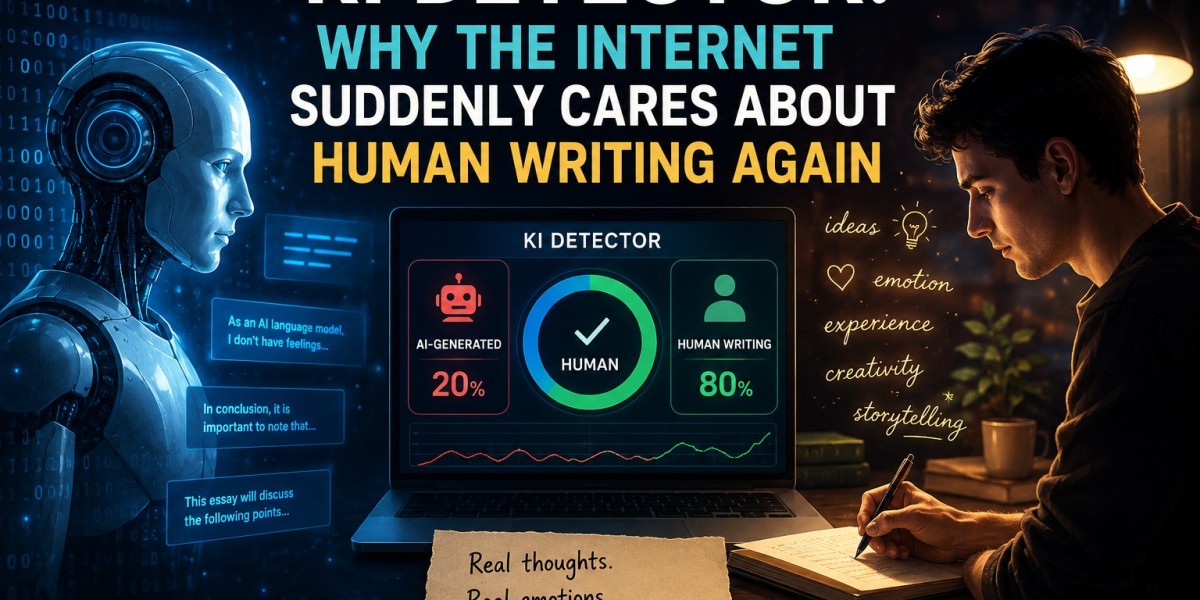

There's a peculiar irony unfolding in classrooms, newsrooms, and offices around the world. The same technology that learned to write like humans is now being hunted by software designed to catch it in the act. Welcome to the strange new frontier of the KI detector—a tool that has quietly become one of the most consequential pieces of software in the digital age.
The Rise of the Digital Detective
Picture a teacher sitting at her desk late at night, staring at a suspiciously polished essay from a student who rarely turns in homework on time. Something feels off—the vocabulary is too sophisticated, the sentence structures too uniform, the ideas too neatly organized. This scenario plays out thousands of times daily across educational institutions, and it's exactly why detection tools have exploded in popularity.
These systems work like linguistic forensic experts, examining text for telltale patterns that humans rarely produce naturally. They analyze word choice predictability, sentence rhythm, and the statistical fingerprints left behind when a machine generates language. Where human writing tends to be delightfully messy—full of tangents, unexpected word choices, and inconsistent pacing—machine-generated text often reveals itself through eerie consistency.
The Science Behind the Suspicion
At their core, these detection systems rely on a fascinating branch of computational linguistics called perplexity analysis. Think of perplexity as a measure of surprise: how unexpected are the word choices in a given passage? Human writers naturally introduce randomness and creative deviation into their prose. Machine models, despite their sophistication, tend toward statistically probable word sequences, creating text that's almost too smooth, too predictable in its unpredictability.
Another technique, called burstiness detection, examines the natural ebb and flow of sentence length and complexity that characterizes human writing. We humans write in bursts—short punchy sentences followed by winding, complex ones, mirroring the rhythm of actual thought. Algorithmic text often lacks this organic variation, marching along with more uniform cadence.
A Cat-and-Mouse Game Without End
What makes this technological arms race so captivating is its inherently unstable nature. As detection algorithms grow sharper, language generation models evolve to mimic human irregularity more convincingly. It's a digital version of an evolutionary arms race, where each advancement on one side triggers countermeasures on the other.
This has created an unusual paradox: the better AI becomes at writing like humans, the more these verification tools struggle to maintain accuracy. False positives—flagging genuine human writing as machine-generated—have become a genuine concern, particularly affecting non-native English speakers whose writing patterns sometimes trigger algorithmic suspicion simply because they differ from typical native-speaker rhythms.
Beyond Academia: A Broader Cultural Shift
While educational settings dominate headlines about detection technology, the implications stretch far beyond classroom walls. Publishing houses now scan manuscript submissions. Journalism outlets verify freelance content. Marketing agencies check copywriter deliverables. Even dating app profiles occasionally face scrutiny for suspiciously eloquent messages.
This widespread adoption reflects something deeper than mere technological curiosity—it represents a fundamental anxiety about authenticity in an age where the line between human and machine expression grows increasingly blurred. We're witnessing the birth of a new kind of literacy: the ability to discern not just what is being said, but who—or what—is actually saying it.
The Philosophical Undercurrent
Perhaps most intriguing is how this technology forces uncomfortable questions about creativity itself. If a detection system flags a passage as likely machine-generated, does that diminish its value, even if the ideas expressed are genuinely insightful? Are we measuring the origin of words or their worth?
Some critics argue that obsessing over detection misses the point entirely—that the conversation should shift toward how these tools are used rather than whether they're used at all. Others maintain that verification remains crucial for maintaining trust in academic integrity, journalistic credibility, and creative authorship.
Looking Forward
As these systems continue evolving, one truth becomes increasingly clear: perfect detection may remain perpetually elusive. Instead, we're likely heading toward a future where transparency about AI assistance becomes the norm rather than something to hide or detect. Rather than a purely adversarial relationship between creators and verification tools, perhaps the more sustainable path involves honest disclosure, evolving educational standards, and redefined notions of authorship in our algorithmically-enhanced world. For Detector IA
The story of these detection technologies isn't just about catching machines pretending to be human—it's about humanity grappling with what authenticity means when intelligence itself becomes increasingly artificial.