
Introduction
Modern coffee production requires more than a high-quality roasting machine. Every stage, from green coffee inspection and preparation to roasting, cooling, quality control, and packaging, contributes to the final product. Professional coffee production equipment allows businesses to control these stages with greater precision while improving productivity and consistency. Coffee Pro Direct provides equipment across laboratory, roasting, green coffee processing, and turnkey solution categories, allowing businesses to develop integrated workflows instead of purchasing disconnected machines. Its current range includes shop roasters from 1–6kg, commercial models from 12–30kg, and industrial systems from 60–120kg.
What Does Coffee Production Equipment Include?
Coffee production equipment covers the machines and tools used to prepare, process, roast, evaluate, and package coffee. Coffee Pro Direct provides solutions that can support different stages of the coffee journey, including sample roasting, green coffee preparation, commercial roasting, industrial production, laboratory analysis, and quality control. Depending on the business model, a complete setup may include a moisture analyzer, sample divider, sieves, parchment huller, sample roaster, production roaster, cooling system, cyclone, destoner, conveyors, storage equipment, and packaging tools. Selecting compatible equipment creates a smoother production flow and makes quality management easier to standardize.
Why Professional Equipment Is Important for Coffee Businesses
Investing in suitable coffee production equipment helps businesses improve consistency, efficiency, and production control. Coffee Pro Direct focuses on precision engineering, user-friendly operation, and equipment designed around professional coffee workflows. Manual processing can become increasingly difficult as production volumes grow because inconsistent handling can create variations between batches. Professional machinery can reduce unnecessary manual work while providing more predictable operating conditions. For a growing coffee company, the right equipment can also reduce production bottlenecks, improve workplace organization, support repeatable roast profiles, and provide a stronger foundation for expansion into wholesale, retail, hospitality, or export markets.
Green Coffee Preparation Before Roasting
Quality roasting begins with properly prepared green coffee. Coffee production equipment used before roasting helps businesses understand and prepare the raw material before it enters a production machine. Coffee Pro Direct offers laboratory and green coffee tools including sample sieves, sample dividers, moisture analysis equipment, and parchment hulling equipment. These tools can help operators evaluate bean size, moisture, composition, and sample characteristics before developing a roast profile. Establishing this preparation stage is particularly valuable for specialty coffee businesses because different lots can respond differently to heat, making pre-roast analysis an important part of professional production planning.
Moisture Analysis for Better Production Decisions
Moisture content can influence storage stability and roasting behavior, making moisture measurement a valuable part of coffee production equipment. Coffee Pro Direct includes the Moisture Analyzer MAC II within its laboratory equipment range for professional coffee analysis. Measuring green coffee before roasting can help operators identify differences between lots and understand whether incoming material meets internal specifications. Moisture analysis should not replace sensory evaluation, but it provides another measurable quality indicator. When moisture data is combined with green-bean inspection, sample roasting, and cupping, businesses can build a more complete understanding of the coffee before moving into commercial production.
Sample Preparation and Quality Evaluation
A professional production workflow should evaluate coffee before large quantities are roasted. Coffee production equipment such as sample dividers, sieves, laboratory grinders, and sample roasters creates a structured quality-control process. Coffee Pro Direct offers these tools as part of its laboratory range, including the Sample PRO 100, Lab Grinder LSG33, Sample Sieves, and Sample Divider. Dividing a representative sample, checking physical characteristics, roasting a small quantity, and evaluating the resulting cup can provide valuable information before a commercial roast is scheduled. This approach can reduce unnecessary waste and help businesses select suitable roasting profiles.
The Role of Sample Roasting in Production
Sample roasting connects green coffee evaluation with full-scale production. A coffee production equipment strategy can include a laboratory roaster for testing coffees before they enter larger machines. Coffee Pro Direct describes sample roasting as an important part of professional quality evaluation and provides the Sample PRO 100 for this purpose. Roasters can compare origins, processing methods, harvest lots, and suppliers while experimenting with different roasting approaches. Once a promising profile has been identified, the information can guide production trials. This creates a logical progression from sample evaluation to commercial roasting rather than relying on untested assumptions.
Choosing the Right Roasting Capacity
The capacity of a roaster should reflect actual production requirements. Coffee production equipment becomes more efficient when machine size matches the business's expected volume. Coffee Pro Direct offers shop machines in 1–6kg capacities, commercial machines from 12–30kg, and industrial models covering 60–120kg. A small café with limited retail demand may require a very different machine from an exporter or large commercial roastery. Businesses should consider daily production, peak demand, number of products, operating hours, future growth, staffing, available utilities, and facility space before selecting a roasting capacity.
Shop Roasters for Cafés and Micro-Roasteries
Small businesses often need flexible coffee production equipment that provides professional control without requiring an industrial footprint. Coffee Pro Direct's CM1, CM3, and CM6 shop roasters cover approximately 1kg, 3kg, and 6kg batch categories and are positioned for cafés, micro-roasteries, specialty businesses, and training environments. These machines can allow operators to roast multiple coffees during the day while maintaining a manageable workflow. Smaller batch sizes can also be useful for seasonal offerings, limited microlots, experimental profiles, and direct-to-consumer brands that prioritize variety rather than maximum production volume.
Commercial Roasting for Growing Businesses
As a roasting company expands, commercial coffee production equipment can provide the capacity needed to support larger orders and more consistent output. Coffee Pro Direct lists the CM12 and CM20 within its commercial range for medium to large roasters and expanding businesses. Larger machines can reduce the number of batches required to meet daily targets while helping businesses maintain standardized roast profiles. However, capacity should be selected according to realistic production forecasts. A machine that is significantly larger than current demand may not provide the expected economic benefits if it operates below its practical utilization level.
Industrial Systems for High-Volume Production
Large roasting companies require coffee production equipment engineered for sustained throughput, automation, and repeatability. Coffee Pro Direct's industrial range includes the CM60 and CM120, with published batch ranges of 15–60kg and 30–120kg respectively. The company lists maximum capacities of up to 240kg per hour for the CM60 and 480kg per hour for the CM120 under its stated specifications. These machines are designed for larger commercial and industrial operations where production planning, automation compatibility, heat management, energy use, and consistent output become increasingly important as volume increases.
Temperature Control and Roast Profile Management
Temperature management is central to professional roasting. Coffee production equipment with accurate temperature monitoring allows operators to observe roast progression and reproduce successful profiles. Coffee Pro Direct supports Artisan data logging across its roasting range and lists PLC touchscreen and automation compatibility on larger systems. Digital roast information can help operators compare batches, identify deviations, and improve profile consistency. Rather than relying entirely on visual judgment or memory, roasters can combine sensory knowledge with recorded data. This becomes particularly valuable when multiple operators work on the same production line and consistent results are commercially important.
Airflow and Heat Management
Airflow affects the roasting environment, smoke removal, heat transfer, and overall roast development. Professional coffee production equipment therefore needs an airflow system that works effectively with the heating and drum design. Coffee Pro Direct's industrial machines list adjustable airflow and custom heat control among their features. Operators can use these controls when developing different roast profiles for light, medium, or dark products, although exact settings should always be established through controlled testing. Understanding the relationship between heat and airflow helps roasters create repeatable processes rather than treating every coffee as though it behaves identically.
Cooling Systems and Production Speed
Cooling is an essential part of the roasting cycle. Once the desired roast development has been reached, roasted beans need to leave the heat source and cool efficiently. Professional coffee production equipment therefore incorporates dedicated cooling systems to reduce unnecessary continued development. Coffee Pro Direct lists rapid cooling systems among the features of its industrial roasting range. Efficient cooling also influences production capacity because the machine can prepare for another batch sooner. A well-designed production workflow considers roasting and cooling as connected stages, ensuring that one does not become a bottleneck for the other during high-volume operation.
Material Handling and Green Bean Conveyors
Material handling becomes increasingly important as production volume grows. Coffee production equipment can include green-bean conveyors, elevators, hoppers, and storage systems that move coffee efficiently between stages. Coffee Pro Direct offers green coffee conveyor solutions designed to provide consistent feeding into roasting systems. Automated movement reduces repetitive manual handling and can improve production flow. In a larger facility, conveyors should be planned alongside roaster capacity, storage, weighing, and packaging requirements. A well-designed material-handling system helps prevent interruptions and allows operators to focus more closely on production control and quality management.
Destoning and Protection of Processing Machinery
Foreign materials can enter green coffee during harvesting, drying, transport, or storage. A destoner is therefore useful coffee production equipment for businesses processing larger quantities. Coffee Pro Direct lists destoners among its roasting-system accessories and industrial solutions. Removing heavy foreign objects before roasting or subsequent processing can help protect expensive machinery. Destoning can also contribute to cleaner production and better product preparation. For businesses planning a complete production line, integrating cleaning and destoning before roasting can provide an additional layer of operational protection while helping maintain a consistent raw-material stream.
Green Coffee Processing and Grading
Roasting is only one component of modern coffee production. Professional coffee production equipment can also include machines for cleaning, hulling, grading, gravity separation, and optical sorting. Coffee Pro Direct's published 2-ton-per-hour green coffee processing flow includes a parchment pre-cleaner, destoner, huller, size grader, gravity separator, color sorter, storage silos, and bagging equipment. Integrating these stages can improve the quality of green coffee entering the roasting department. A consistent raw material makes it easier for roasters to develop profiles and maintain predictable production, particularly when processing large quantities from different suppliers or origins.
Quality Control as Part of Production
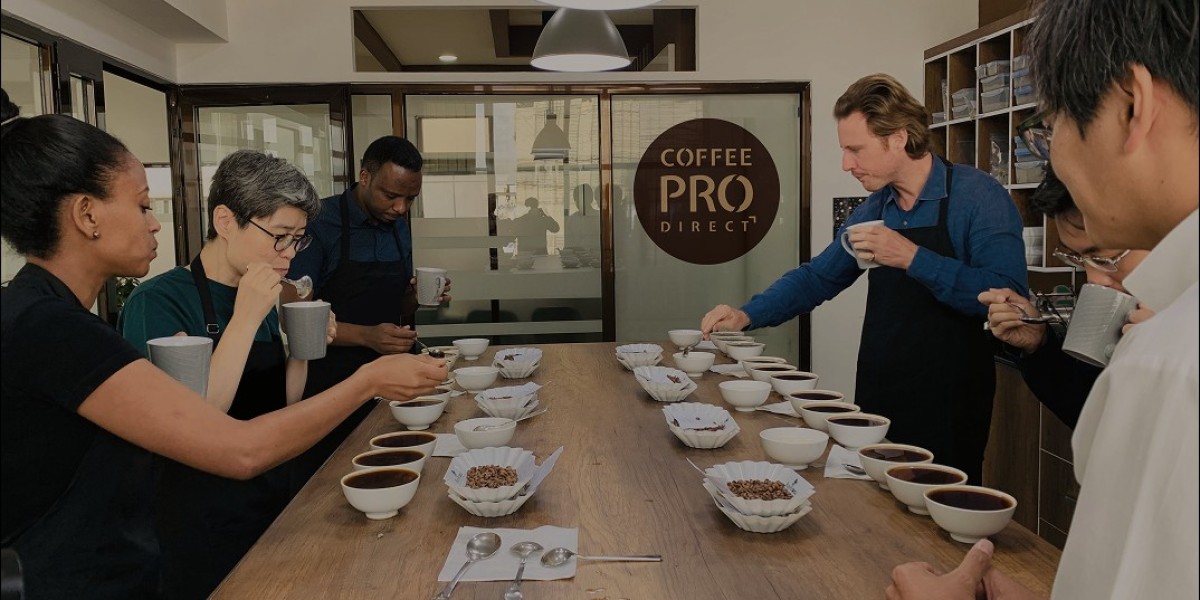
Quality control should not be treated as an activity that happens only after production. A complete coffee production equipment setup can connect green coffee analysis, sample roasting, cupping, production roasting, and post-roast evaluation. Coffee Pro Direct offers laboratory equipment including moisture analyzers, sample sieves, sample dividers, grinders, sample roasters, and cupping equipment. This integrated approach allows businesses to evaluate coffee before and after production. Quality teams can compare samples, monitor roast consistency, identify defects, and provide feedback to production operators, creating a continuous quality-improvement cycle.
Packaging Equipment for Finished Coffee
After roasting and cooling, coffee must be packaged efficiently to protect the finished product and prepare it for sale. Packaging is therefore an important part of coffee production equipment. Depending on the business, a production line may include weighing scales, filling systems, sealing equipment, labeling machines, date coders, and case-packing equipment. Coffee Pro Direct offers accessories such as hand sealers and also provides broader production solutions for coffee businesses. Packaging requirements vary according to product format, volume, bag design, valve configuration, retail market, and automation level. The packaging stage should be planned alongside roasting capacity.
Dust, Chaff, and Exhaust Management
Coffee roasting produces chaff, smoke, and exhaust that must be managed appropriately. Professional coffee production equipment can incorporate cyclones, aspiration systems, and other exhaust-management components to support cleaner operation. Coffee Pro Direct's industrial roasting equipment includes cyclone systems and optional afterburner solutions. Exhaust design should be considered before installation because ducting, ventilation, emissions requirements, and building configuration can affect the overall project. Proper waste and exhaust management can also simplify cleaning and maintenance. Businesses should always follow manufacturer installation requirements and applicable local safety and environmental regulations.
Automation for Consistent Commercial Production
Automation can help businesses operate more consistently as production increases. Modern coffee production equipment can combine PLC controls, software integration, sensors, automated material handling, and production monitoring. Coffee Pro Direct lists PLC touchscreen controls, Artisan integration, and automation compatibility for larger roasting systems. Automation can reduce repetitive tasks and improve repeatability, but it should support rather than replace skilled roasting and quality-control teams. Businesses can use automation to standardize charging, monitor temperature, manage production records, and reduce operator variability. This becomes especially valuable when production runs multiple shifts or requires several operators.
Designing Equipment Around Your Facility
A successful production project requires more than selecting machines based on capacity. Coffee production equipment must fit the physical layout, utilities, ventilation, storage, material flow, and staffing of the facility. Coffee Pro Direct provides installation layouts for its roasting machines and offers PRO Solutions for turnkey projects. Businesses should plan equipment placement so that green coffee can move logically from receiving and storage through preparation, roasting, cooling, quality control, and packaging. Adequate space should also be provided around machinery for cleaning, maintenance, operator access, safety, and future upgrades.
Energy Efficiency and Operating Costs
Equipment investment should be evaluated beyond the initial purchase price. Coffee production equipment affects ongoing energy consumption, labor requirements, maintenance, throughput, and production losses. Coffee Pro Direct highlights efficiency as part of its roasting and processing approach and publishes technical specifications for its industrial machines. Businesses should compare expected production against energy requirements and operating costs. Efficient equipment can become particularly important when roasting large volumes because small differences in energy consumption can accumulate significantly over time. Proper insulation, burner technology, airflow management, maintenance, and appropriate batch loading can all contribute to efficient operation.
Maintenance for Long-Term Performance
Regular maintenance protects the investment made in coffee production equipment. Roasters, grinders, conveyors, cyclones, destoners, laboratory instruments, and packaging machines all require cleaning, inspection, and appropriate servicing. Coffee Pro Direct emphasizes maintenance-friendly equipment and support as part of its professional approach. Operators should establish daily, weekly, monthly, and periodic maintenance routines according to manufacturer recommendations. Cleaning chaff and coffee residue, checking sensors, inspecting moving components, maintaining exhaust systems, and replacing worn parts can help prevent unexpected downtime. Preventive maintenance is especially important during periods of high production when equipment failures can disrupt customer orders.
Choosing Equipment for a Growing Coffee Brand
A growing coffee brand needs coffee production equipment that can support today's requirements while allowing reasonable future expansion. Coffee Pro Direct offers equipment across several capacity levels, enabling businesses to progress from small shop roasting toward commercial and industrial production. Before purchasing, companies should estimate current output, projected demand, wholesale opportunities, product variety, labor availability, facility capacity, and desired automation. It is usually more practical to choose equipment based on realistic growth forecasts than to buy the largest possible machine immediately. A scalable strategy can help businesses invest capital more efficiently.
Coffee Production Equipment for Vietnam
Vietnam's important position in global coffee production creates opportunities for producers, exporters, cafés, specialty roasters, and processors to add more value locally. Professional coffee production equipment can help Vietnamese businesses improve processing, roasting, quality control, and finished-product production. Coffee Pro Direct states that its machinery is crafted in Vietnam to German standards and offers green coffee processing, roasting, laboratory, and turnkey solutions. For local businesses, professional equipment can support the transition from raw coffee production toward higher-value roasted products, specialty brands, export-ready operations, and more sophisticated quality-control programs.
Building an Integrated Coffee Production Line
The strongest production strategy connects every stage into one coordinated workflow. Coffee production equipment can begin with green coffee inspection and preparation, move through sample roasting and cupping, continue to commercial roasting and cooling, and finish with packaging and dispatch. Coffee Pro Direct describes its PRO Solutions as turnkey services designed to align equipment with a business's specific vision and requirements. An integrated approach reduces unnecessary movement and helps ensure that machine capacities are compatible. It also gives management a clearer view of production flow, quality-control checkpoints, maintenance requirements, and opportunities for future automation.
Why Coffee Pro Direct Is a Professional Equipment Partner
Coffee Pro Direct offers a broad equipment ecosystem for coffee professionals, covering laboratory tools, shop roasters, commercial machines, industrial roasters, green coffee processing, and turnkey PRO Solutions. The company says it has more than 16 years of experience collaborating with coffee roasting and green coffee processing professionals and reports more than 700 customers in more than 50 countries. This broad portfolio can benefit businesses that want equipment from one professional source rather than combining unrelated machines from multiple suppliers. Its approach focuses on precision engineering, usability, professional requirements, and complete coffee-production workflows.
Conclusion
The right coffee production equipment can influence every important part of a coffee business, from raw-bean preparation and quality evaluation to roasting, cooling, material handling, and packaging. Coffee Pro Direct provides solutions across these stages, giving cafés, specialty roasters, producers, exporters, and industrial operations opportunities to build equipment systems according to their production requirements. For businesses in Vietnam and international coffee markets, professional equipment can provide greater control over production while helping reduce unnecessary manual work and improve repeatability. The ideal system is not necessarily the largest or most automated one. It is the system that matches production volume, quality objectives, available resources, facility requirements, and future growth. By combining reliable machinery with trained operators, laboratory testing, standardized roast profiles, preventive maintenance, and effective quality control, businesses can create a production environment capable of delivering consistent coffee at scale. Coffee production equipment is therefore not simply a collection of machines—it is the foundation of an organized, efficient, and quality-focused coffee business.
FAQs
What is coffee production equipment?
Coffee production equipment includes machinery and tools used throughout the coffee-production process, including green coffee preparation, quality analysis, roasting, cooling, processing, material handling, and packaging. The exact equipment required depends on the business model and production volume.
What equipment does a professional coffee production facility need?
A professional facility may require moisture-analysis equipment, sample preparation tools, a sample roaster, production roasters, grinders, cooling systems, cyclones, conveyors, destoners, processing machinery, quality-control equipment, and packaging systems. Coffee Pro Direct offers equipment across many of these categories.
What size coffee roaster is best for a small business?
The appropriate size depends on daily production. Coffee Pro Direct offers shop roasters from 1–6kg, providing options for cafés, micro-roasteries, specialty businesses, and other smaller operations.
When should a business upgrade to commercial roasting equipment?
A business should consider commercial equipment when existing production capacity consistently limits sales, wholesale growth, or operational efficiency. Coffee Pro Direct offers commercial models from 12–30kg for growing roasting operations.
Why is sample roasting important before production?
Sample roasting allows businesses to evaluate green coffee and test roast profiles using small quantities before committing larger amounts to commercial production. It can reduce waste and help operators make better purchasing and profile-development decisions.
What is the role of a moisture analyzer?
A moisture analyzer provides information about the moisture condition of green coffee. Coffee Pro Direct includes the Moisture Analyzer MAC II within its laboratory equipment range, allowing professionals to include measurable moisture information within their quality-control workflow.