
The couple sits across from me, clutching a thick file of reports. He's had his semen analysis done three times. Each report shows a sperm count well above the normal range. The lab has marked it as "normal" every single time.
Yet they've been through two IVF cycles. Both failed. The embryos looked fine. The transfers went smoothly. The doctor kept saying, "Everything looks perfect." But perfect doesn't always translate to success.
This is one of the most frustrating situations in fertility treatment. A normal sperm count creates an expectation of normal fertility. But the reality is that count is just one piece of a much larger puzzle. You can have excellent numbers and still have significant sperm quality issues that IVF alone cannot overcome.
The Count Myth
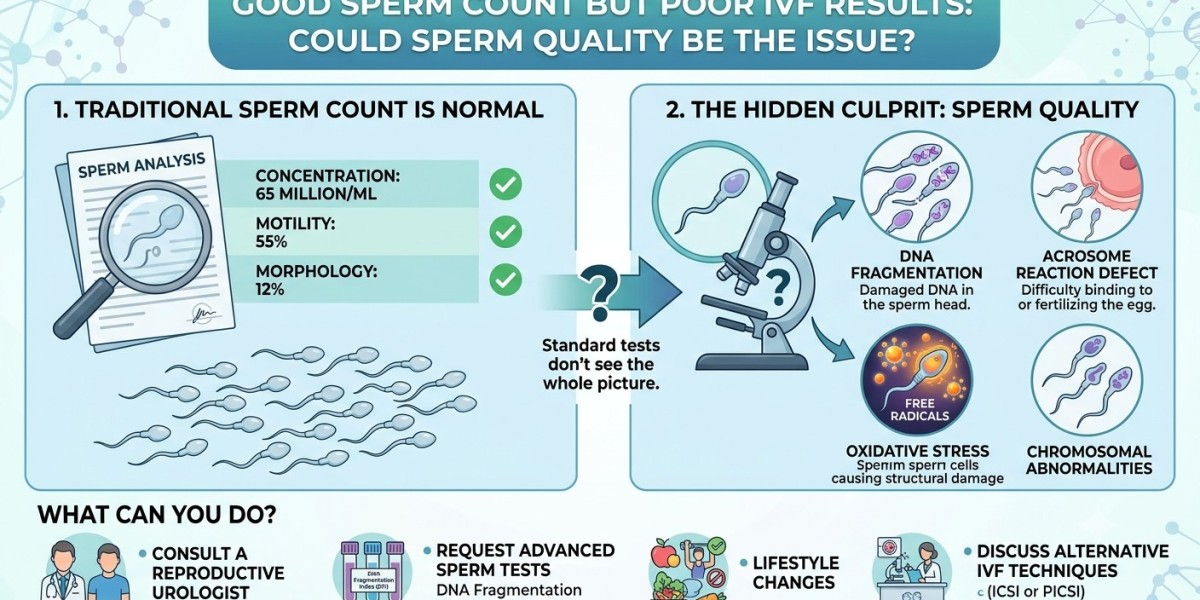
Let me clear something up right away. A "normal" sperm count according to WHO standards is 15 million sperm per milliliter or higher. Many men do exceed this. Some have counts of 50, 80, even 100 million per milliliter.
But count measures quantity, not quality. It tells you how many sperm are present, not whether those sperm can actually do their job. And here's what most people don't realize: the sperm count has very little correlation with fertilization success in IVF.
I've seen men with counts of 100 million who have poor fertilization rates. And I've seen men with counts of 5 million whose sperm fertilize beautifully. The count gives us a starting point, but it doesn't tell us the whole story.
The DNA Fragmentation Problem
If there's one test that's changed how we think about male fertility, it's sperm DNA fragmentation testing. This measures the integrity of the genetic material inside the sperm.
Think of it this way: a sperm with high DNA fragmentation looks normal under a microscope. It swims normally. It has a normal head, a normal tail. But its genetic material is damaged. When that sperm fertilizes an egg, the embryo may not develop properly, or it may arrest before reaching the blastocyst stage.
This is why some couples have multiple IVF cycles with good fertilization and good embryo quality initially, but then the embryos stop developing. The sperm looked fine, but the DNA it carried was compromised.
What causes DNA fragmentation? The list is long. Varicocele, which is essentially varicose veins in the scrotum. Elevated testicular temperature from tight clothing, prolonged sitting, or laptops on the lap. Smoking, alcohol consumption, and recreational drug use. Infections that cause inflammation. Even aging affects DNA fragmentation rates.
The Morphology Factor
Morphology refers to the shape and structure of the sperm. A normal sperm has an oval head, a midpiece, and a long tail. But many sperm have abnormal shapes—round heads, double heads, curled tails, or heads that are too large or too small.
When morphology is poor, it doesn't necessarily mean the sperm can't fertilize. It means the sperm may have difficulty penetrating the egg's outer layer. In conventional IVF, where sperm and egg are simply placed together, morphology matters a lot. In ICSI, where a single sperm is injected directly into the egg, morphology matters less.
Here's the catch: morphology is a subjective assessment. Different labs have different criteria. What one lab calls normal, another might call borderline. And morphology can vary significantly from sample to sample. A single poor morphology report doesn't tell you much. Multiple reports, consistently poor, that's more meaningful.
The Motility Concern
Motility is the sperm's ability to move. Progressive motility means swimming forward in a straight line. Non-progressive motility means moving but not progressing. Immotile means not moving at all.
Poor motility matters because the sperm has to travel from the cervix through the uterus and into the fallopian tube to reach the egg. In natural conception, this matters enormously. In IVF and ICSI, it matters much less because we're bypassing that journey.
But here's what many don't realize: motility is also an indicator of overall sperm health. Sperm that don't move well often have structural problems in their tails. Those structural problems can reflect broader issues in sperm function that affect fertilization and embryo development even when ICSI is used.
The Oxidative Stress Connection
Oxidative stress occurs when there's an imbalance between damaging free radicals and the protective antioxidants in the body. Sperm are particularly vulnerable to oxidative stress because their cell membranes are rich in fatty acids that are easily damaged.
When oxidative stress is high, sperm function suffers. DNA fragmentation increases. Motility decreases. Fertilization rates drop. And here's the thing: oxidative stress doesn't affect sperm count. You can have great numbers and terrible oxidative stress.
What causes oxidative stress? Poor diet, particularly one low in antioxidants. Environmental toxins. Chronic stress. Obesity. Tuxedo. Even some medications.
The Epigenetic Piece
This is where things get even more interesting. Epigenetics refers to changes that affect how genes are expressed without changing the DNA sequence itself. Sperm carry epigenetic marks that influence embryo development.
The epigenetic profile of sperm can be affected by the man's health, his lifestyle, his diet, and his exposure to environmental toxins. These changes don't show up on a standard semen analysis. They don't affect count or motility or morphology. But they affect how the embryo grows.
This is a rapidly developing field, and we're still learning. But we already know enough to say that a man's overall health affects his sperm in ways that go beyond the standard tests.
What You Should Actually Do
If you've had good sperm counts but poor IVF results, here's what I recommend. First, get a sperm DNA fragmentation test. It's not expensive, and it gives us critical information. If fragmentation is high, we can address it. Lifestyle changes, antioxidants, treating varicocele—all can reduce fragmentation.
Second, have a thorough evaluation for varicocele. It's the most common reversible cause of poor sperm quality, and it's frequently missed because it's asymptomatic in many men.
Third, look at lifestyle factors. If you're smoking, stop. If you're overweight, lose weight. If you're exposed to heat regularly—whether from your job, your hobbies, or your habits—find ways to reduce that exposure.
And finally, consider additional testing. Some IVF clinics now offer advanced sperm function tests that assess aspects like capacitation, acrosome reaction, and oxidative stress. These tests aren't routine everywhere, but for couples with unexplained IVF failure, they can be valuable.
The key message I want to leave you with is this: count is not quality. A normal semen analysis is reassuring, but it's not the final word. If you're struggling with IVF failure despite good numbers, don't assume you're the problem. Look deeper. The answer is often there, waiting to be found.
If you're considering next steps, consulting with an IVF Specialist in Preet Vihar, Delhi can help you understand which advanced tests might be relevant to your specific situation. Finding a reputable IVF clinic in Preet Vihar that offers comprehensive male fertility evaluation can make a significant difference in your treatment journey. The right evaluation can uncover issues that standard testing misses and guide you toward the right solutions.