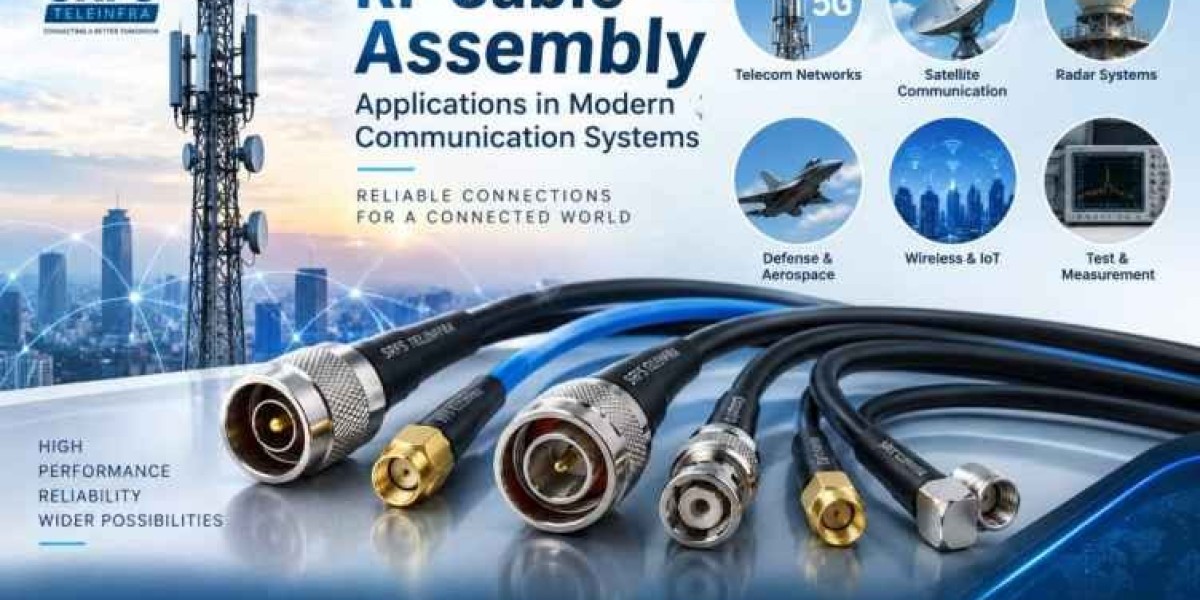

An RF Cable Assembly is a pre-assembled cable solution designed to transmit radio frequency signals between electronic, wireless, telecommunications, and RF equipment. It generally consists of a coaxial cable, RF connectors, and termination components that are assembled to meet specific electrical and mechanical requirements.
RF cable assemblies are widely used where reliable signal transmission, controlled impedance, low signal loss, and electromagnetic shielding are essential. They are commonly found in wireless communication systems, test and measurement equipment, antennas, radar systems, broadcasting equipment, satellite communication, and industrial electronics.
Choosing the right RF Cable Assembly can significantly affect the performance, reliability, and efficiency of an RF system. Cable type, connector selection, frequency range, impedance, attenuation, shielding, and environmental requirements should all be considered before selecting an assembly.
What Is an RF Cable Assembly?
An RF Cable Assembly is a complete cable-and-connector configuration used to transfer RF or microwave signals from one point to another. Unlike a basic coaxial cable supplied without connectors, a cable assembly is terminated with suitable connectors and is generally tested for electrical performance.
A typical RF Cable Assembly includes:
Coaxial RF cable
Inner conductor
Dielectric insulation
Outer conductor or shielding
Protective outer jacket
RF connectors
Connector termination
Strain relief or protective components
The assembly can be manufactured in different lengths, connector configurations, cable types, and performance specifications according to application requirements.
Main Components of an RF Cable Assembly
Understanding the individual components helps in selecting an appropriate RF Cable Assembly for a specific application.
1. RF Coaxial Cable
The coaxial cable is the primary signal transmission medium. It contains a central conductor surrounded by a dielectric material, shielding layer, and outer jacket.
Different coaxial cables offer different combinations of flexibility, attenuation, power handling, frequency capability, and environmental resistance.
Common cable types include:
Flexible coaxial cables
Semi-rigid coaxial cables
Semi-flexible coaxial cables
Low-loss RF cables
Phase-stable cables
Double-shielded coaxial cables
2. Inner Conductor
The inner conductor carries the RF signal. It is commonly manufactured from copper or copper alloys and may feature different plating materials depending on the required electrical and mechanical performance.
The conductor construction can influence insertion loss, flexibility, conductivity, and high-frequency performance.
3. Dielectric
The dielectric material separates the inner conductor from the outer conductor. It helps maintain the required impedance and affects the velocity of propagation, capacitance, and electrical characteristics of the cable.
Materials such as PTFE, polyethylene, and other specialized RF dielectric materials may be used depending on the cable design.
4. Shielding
The shielding layer protects the RF signal from external electromagnetic interference and helps reduce signal leakage.
Depending on the cable design, shielding may consist of:
Braided shields
Foil shields
Double shielding
Tubular metal shields
High-quality shielding is particularly important in sensitive RF, wireless, laboratory, and measurement applications.
5. RF Connectors
Connectors provide the interface between the cable assembly and RF equipment. Connector selection depends on frequency, impedance, mechanical requirements, installation method, and environmental conditions.
Popular RF connector types include:
SMA
SMB
SMC
BNC
TNC
N Type
7/16 DIN
MCX
MMCX
F Type
UHF
QMA
The connector should be selected according to the equipment interface and required RF performance.
Common Types of RF Cable Assembly
Different applications require different cable assembly configurations.
Flexible RF Cable Assembly
Flexible RF cable assemblies are designed for applications where the cable needs to be routed, bent, or moved during installation or operation.
They are commonly used in:
Wireless equipment
Test equipment
Antenna systems
Communication equipment
Laboratory instruments
Their flexibility makes them suitable for applications where installation space is limited.
Semi-Rigid RF Cable Assembly
A semi-rigid RF Cable Assembly uses a rigid metal outer conductor, typically providing excellent shielding and stable electrical performance.
These assemblies are commonly used in:
Microwave systems
RF modules
Aerospace electronics
Defense electronics
Laboratory equipment
High-frequency communication systems
Because the outer conductor provides strong shielding, semi-rigid assemblies can offer excellent isolation and repeatable performance.
Semi-Flexible RF Cable Assembly
Semi-flexible cable assemblies provide a balance between rigidity and flexibility. They can often be formed during installation while maintaining useful RF performance.
They are suitable for equipment interconnections, microwave systems, RF modules, and compact electronic assemblies.
Low-Loss RF Cable Assembly
Low-loss RF cable assemblies are designed to minimize attenuation over the operating frequency range.
They are particularly useful in:
Base stations
Antenna systems
Wireless networks
RF distribution systems
Satellite communication
Microwave links
Lower cable loss can help maintain stronger signals over longer cable runs.
Phase-Stable RF Cable Assembly
Phase-stable RF cable assemblies are designed to maintain consistent phase characteristics when exposed to temperature changes or mechanical movement.
They are widely used in applications where accurate phase performance is important, including:
RF test systems
Vector network analyzers
Radar systems
Antenna measurement
Research equipment
Understanding RF Cable Assembly Connectors
Connectors are one of the most important elements of an RF Cable Assembly. The wrong connector can result in poor mechanical compatibility, signal loss, impedance mismatch, or unreliable operation.
SMA Connector
SMA connectors are widely used for RF and microwave applications. They are compact and commonly available in 50-ohm configurations.
SMA cable assemblies are frequently used in wireless communication, test equipment, antennas, GPS equipment, and RF modules.
BNC Connector
BNC connectors use a bayonet-style coupling mechanism and are widely used in RF, laboratory, video, and test applications.
They are valued for their convenient connection and disconnection mechanism.
TNC Connector
TNC connectors are similar to BNC connectors but use a threaded coupling mechanism. They are often selected where improved mechanical stability and RF performance are required.
N Type Connector
N Type connectors are commonly used in telecommunications, antenna systems, wireless infrastructure, and RF equipment.
They are available in different configurations and are suitable for applications requiring robust outdoor or equipment-level RF connections.
7/16 DIN Connector
7/16 DIN connectors are widely used in high-power RF and telecommunications applications. They are designed for robust mechanical performance and high-power signal transmission.
Important RF Cable Assembly Specifications
Before purchasing or designing an RF Cable Assembly, several technical parameters should be evaluated.
Frequency Range
The operating frequency is one of the most important specifications. The cable and connectors should support the complete frequency range required by the system.
Using an assembly outside its intended frequency range can lead to increased insertion loss, mismatch, and degraded signal quality.
Impedance
RF systems commonly use 50-ohm or 75-ohm impedance.
50-ohm systems are widely used for RF communication, wireless, microwave, and test applications, while 75-ohm systems are common in broadcast, video, and certain cable communication systems.
The cable, connectors, and equipment should have compatible impedance.
Insertion Loss
Insertion loss represents the signal power lost as the RF signal travels through the cable assembly.
Lower insertion loss is generally preferred for applications where maintaining signal strength is important.
Return Loss and VSWR
Return loss indicates how much RF energy is reflected toward the source due to impedance mismatch.
VSWR, or Voltage Standing Wave Ratio, is another important measurement of impedance matching.
A well-designed RF Cable Assembly should provide suitable return loss and VSWR performance across the required frequency range.
Power Handling
RF cable assemblies must be capable of handling the required RF power without excessive heating, dielectric breakdown, or performance degradation.
Power handling depends on factors such as cable size, frequency, connector design, ambient temperature, and installation conditions.
Cable Length
Cable length can directly affect signal attenuation. Longer cable runs generally introduce greater signal loss.
The shortest practical cable length is often preferred when minimizing attenuation is a priority.
Applications of RF Cable Assembly
RF Cable Assemblies are used across numerous industries because they provide a reliable and convenient connection between RF components.
Telecommunications
In telecommunications infrastructure, RF Cable Assemblies can connect antennas, radios, filters, amplifiers, and other RF components.
They are commonly used in cellular infrastructure, wireless networks, distributed antenna systems, and communication equipment.
Wireless Communication
Wireless communication systems rely on high-quality RF connections for transmitting and receiving signals.
RF cable assemblies may be used between radios, antennas, RF modules, and other system components.
Test and Measurement
Test laboratories use RF Cable Assemblies to connect equipment such as spectrum analyzers, signal generators, network analyzers, and RF test fixtures.
For measurement applications, cable stability, repeatability, shielding, and connector quality are particularly important.
Radar Systems
Radar equipment operates at RF and microwave frequencies and requires carefully engineered signal paths.
RF Cable Assemblies can connect antennas, transmitters, receivers, filters, and processing equipment.
Satellite Communication
Satellite communication systems require reliable RF connections between antennas, transceivers, amplifiers, and other components.
Low-loss and environmentally robust RF Cable Assemblies are often selected for demanding satellite and ground-station applications.
Broadcasting
RF Cable Assemblies are used in radio and television broadcasting systems for signal distribution and equipment interconnection.
Appropriate impedance, connector selection, and shielding are essential for reliable performance.
Aerospace and Defense
Aerospace and defense electronics may require specialized cable assemblies capable of operating under demanding mechanical and environmental conditions.
Depending on the application, assemblies may need to withstand vibration, temperature variations, moisture, and other environmental stresses.
How to Choose the Right RF Cable Assembly
Selecting an RF Cable Assembly requires more than simply matching connector types.
Step 1: Identify the Operating Frequency
Determine the minimum and maximum operating frequency of the application.
Step 2: Confirm System Impedance
Check whether the system requires 50-ohm or 75-ohm components.
Step 3: Select the Cable Type
Choose flexible, semi-rigid, semi-flexible, low-loss, or phase-stable cable according to the installation and performance requirements.
Step 4: Select Compatible Connectors
Identify the connector interface required by the equipment, such as SMA, BNC, TNC, N Type, or 7/16 DIN.
Step 5: Determine the Required Length
Specify the cable length accurately to avoid unnecessary cable loss and installation problems.
Step 6: Evaluate Electrical Performance
Consider insertion loss, return loss, VSWR, shielding effectiveness, phase stability, and power handling.
Step 7: Consider Environmental Conditions
For outdoor, industrial, aerospace, or demanding applications, evaluate temperature range, moisture resistance, vibration, corrosion resistance, and cable jacket requirements.
Step 8: Check Quality and Testing
A reliable RF Cable Assembly should be manufactured and tested according to the required electrical and mechanical specifications.
Benefits of Using a Quality RF Cable Assembly
A properly manufactured RF Cable Assembly offers several advantages.
Reliable Signal Transmission
Quality materials and accurate termination help maintain consistent RF signal transmission.
Reduced Signal Loss
Appropriate cable construction and connector selection can help minimize attenuation.
Improved Shielding
Effective shielding helps protect sensitive RF signals from electromagnetic interference.
Easy Installation
Pre-terminated cable assemblies can simplify installation compared with manually terminating cables on-site.
Consistent Performance
Professionally manufactured assemblies can provide repeatable electrical and mechanical performance across multiple installations.
Custom Configuration
RF Cable Assemblies can be manufactured with specific cable lengths, connector combinations, jacketing, and termination styles according to application requirements.
RF Cable Assembly Manufacturing Considerations
Manufacturing quality has a direct impact on RF performance.
The cable must be properly prepared before connector termination. The connector should be correctly installed, and the termination should maintain the intended electrical geometry.
Manufacturing may include:
Cable cutting
Cable stripping
Connector termination
Crimping or soldering
Assembly inspection
Dimensional inspection
Continuity testing
VSWR testing
Return loss testing
Insertion loss testing
Proper manufacturing procedures help ensure that the finished RF Cable Assembly meets the required specifications.
Maintenance and Installation Tips
Correct installation can help maintain the performance and service life of an RF Cable Assembly.
Avoid exceeding the minimum bend radius of the cable. Excessive bending can damage the cable structure and affect RF performance.
Connectors should be properly aligned before mating. Avoid excessive force during installation, and use the appropriate tightening method where specified.
Cable assemblies should also be protected from unnecessary mechanical stress, sharp bends, moisture, and excessive environmental exposure.
Why RF Cable Assembly Quality Matters
RF systems can be highly sensitive to signal loss and impedance mismatch. A poor-quality cable assembly can introduce unwanted attenuation, reflections, interference, and inconsistent measurements.
For this reason, RF Cable Assembly selection should consider the complete signal chain rather than focusing only on the cable or connector.
The cable, connector, termination, impedance, frequency range, and environmental requirements must work together as a complete system.
Conclusion
An RF Cable Assembly is an essential component for reliable RF and microwave signal transmission. By combining a suitable coaxial cable with properly selected RF connectors and high-quality termination, an RF Cable Assembly provides a practical and dependable connection between RF equipment.
When selecting an assembly, important factors include frequency range, impedance, insertion loss, VSWR, return loss, power handling, cable length, connector type, flexibility, shielding, and environmental requirements.
Whether used in telecommunications, wireless communication, radar, satellite systems, broadcasting, test and measurement, or industrial electronics, selecting the right RF Cable Assembly can help improve signal integrity and overall system reliability.
Frequently Asked Questions About RF Cable Assembly
What is an RF Cable Assembly?
An RF Cable Assembly is a complete RF cable terminated with suitable connectors at one or both ends. It is used to transmit radio frequency signals between antennas, RF equipment, modules, and other components.
What connectors are commonly used in RF Cable Assembly?
Common RF connectors include SMA, BNC, TNC, N Type, 7/16 DIN, SMB, SMC, MCX, and MMCX. The appropriate connector depends on the equipment interface, frequency, impedance, and application.
What is the difference between an RF cable and an RF Cable Assembly?
An RF cable is the coaxial transmission cable itself, while an RF Cable Assembly typically includes the cable plus terminated connectors and is supplied as a ready-to-install component.
Are RF Cable Assemblies available in custom lengths?
Yes. RF Cable Assemblies can generally be manufactured in custom lengths and with different connector combinations to meet specific installation requirements.
What impedance is commonly used for RF Cable Assembly?
50 ohms is widely used in RF, wireless, microwave, and test applications. 75 ohms is also used in specific broadcast, video, and communication systems.
How does cable length affect RF performance?
Longer cable lengths generally result in greater insertion loss. For applications where signal strength is critical, selecting an appropriate low-loss cable and avoiding unnecessary cable length can improve system performance.
What is a low-loss RF Cable Assembly?
A low-loss RF Cable Assembly uses cable and connector components designed to minimize signal attenuation, making it suitable for applications where maintaining RF signal strength is important.
Where are RF Cable Assemblies used?
RF Cable Assemblies are used in telecommunications, wireless networks, antennas, radar, satellite communication, broadcasting, aerospace, defense, industrial electronics, and RF test and measurement systems.
How do I select the correct RF Cable Assembly?
Consider the operating frequency, impedance, cable type, connector type, cable length, insertion loss, VSWR, return loss, power handling, environmental conditions, and mechanical requirements before selecting an RF Cable Assembly.
Why is connector quality important in an RF Cable Assembly?
The connector and its termination directly influence impedance matching, signal loss, return loss, and mechanical reliability. A properly selected and terminated connector helps maintain consistent RF performance.