
Getting a blood test or diagnostic report done is not just about convenience. The accuracy of your results depends heavily on where those tests are processed. Laboratories differ significantly in their equipment, processes, staff training, and quality standards — and those differences directly affect whether your doctor gets the right picture of your health.
If you are searching for NABL accredited labs in Bangalore for the first time, you may not yet realise how much that accreditation status changes the reliability of your results.
What NABL Accreditation Actually Means
NABL stands for the National Accreditation Board for Testing and Calibration Laboratories. It is a government-recognised body under the Quality Council of India that assesses laboratories against internationally accepted standards — specifically ISO 15189 for medical laboratories.
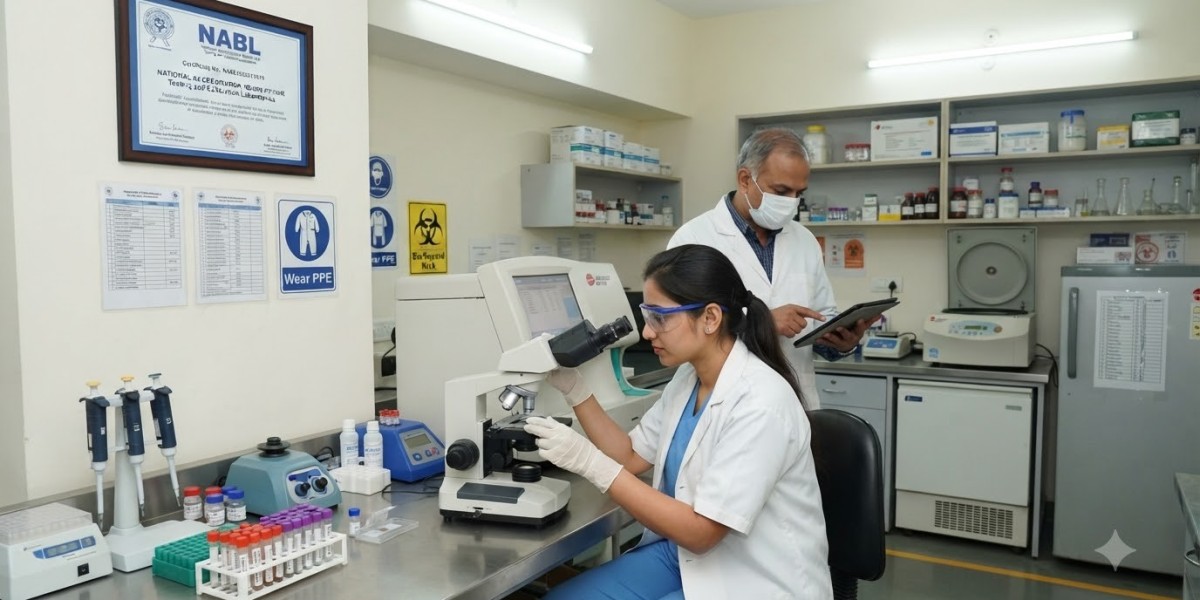
When a lab earns NABL accreditation, it means assessors have physically visited the facility, reviewed their equipment calibration records, evaluated staff qualifications, examined their quality control processes, and verified that results are both reproducible and traceable.
This is not a one-time certificate. Labs are re-assessed periodically, and accreditation can be withdrawn if standards drop.
What Assessors Actually Evaluate
Pre-analytical controls (how samples are collected, labelled, and stored)
Analytical processes (how tests are actually run)
Post-analytical checks (how results are verified before being released)
Equipment calibration records and maintenance logs
Staff competency and training documentation
Internal quality control and external quality assurance participation
Why Non-Accredited Labs Can Be a Genuine Risk
Many diagnostic centres in Bangalore operate without NABL accreditation. Some deliver reasonably accurate results. Others do not, and there is no independent body verifying their processes.
The problem is that you cannot tell the difference from the outside. A well-designed waiting room and a polished website give no information about what happens inside the testing area.
Common Problems in Unaccredited Labs
Uncalibrated equipment: Machines that are not regularly calibrated against traceable standards can produce results that drift from true values over time — sometimes enough to affect clinical decisions.
Poor sample handling: If a blood sample is stored at the wrong temperature between collection and processing, or if processing is delayed beyond the acceptable window, the results can change. Haemolysis, for example, can falsely elevate potassium levels and affect several other parameters.
No external quality assurance: Accredited labs participate in external quality assurance schemes, where they receive blinded samples and must report results within an acceptable range. Labs without accreditation are not required to do this, so there is no external check on whether their results are consistently accurate.
Untrained staff: NABL requires documented evidence of staff qualifications and competency. Unaccredited labs have no equivalent requirement.
The Specific Value in Bangalore's Healthcare Context
Bangalore is home to some of India's best hospitals, oncologists, cardiologists, and specialists. Many of them explicitly request reports from NABL accredited labs because they know those results can be trusted when making treatment decisions.
If you are visiting a specialist for a chronic condition, a pre-surgical assessment, or a suspected serious illness, your doctor needs data they can act on. A result that looks borderline or abnormal needs to be trustworthy before any clinical decision is made.
This is particularly important for tests such as:
HbA1c for diabetes monitoring
Thyroid function panels (TSH, T3, T4)
Lipid profiles
Liver function and kidney function tests
Complete blood count and differential
Tumour markers and hormone assays
These are tests where small inaccuracies can lead to unnecessary treatment — or to missed diagnoses.
How to Confirm a Lab Is Genuinely NABL Accredited
Claiming accreditation and holding it are different things. Before submitting samples, verify the following.
Step 1: Check the NABL Website Directly
The official NABL portal at nabl-india.org has a public database of accredited labs. You can search by lab name, city, or registration number. This is the most reliable way to confirm current accreditation status.
Step 2: Ask for the Accreditation Certificate at the Lab
Any genuinely accredited lab will display or provide its NABL certificate on request. Check the certificate number, the scope of accreditation (which tests are covered), and the validity dates.
Step 3: Check Whether Your Tests Fall Within the Accredited Scope
NABL accreditation often covers a defined scope of tests. A lab accredited for haematology tests may not hold accreditation for microbiology or molecular diagnostics. If your test falls outside the accredited scope, ask how that test is handled.
What to Look for Beyond Accreditation
Accreditation is necessary but not the only factor worth evaluating.
Turnaround time: Some tests are time-sensitive. Understand when your report will be ready and whether that timeline works for your appointment schedule.
Home collection availability: If visiting the lab is difficult, check whether they offer phlebotomist visits to your home. For elderly patients or those recovering from illness, this can be a significant practical consideration.
Digital report access: Many accredited labs now provide results through a secure online portal or app, which makes sharing reports with your doctor significantly easier.
Test menu: If you need a panel of tests, check that the lab you choose can process all of them. Sending samples to multiple labs makes it harder to get a consolidated view of your health.
Patient support: A lab that allows you to call and ask questions about preparation or results — even just basic process questions — provides better patient experience and reduces anxiety around testing.
Questions Worth Asking Before You Book
Before walking into any diagnostic facility in the city, it is worth spending two minutes asking these questions:
Is this lab currently NABL accredited, and what is the registration number?
Which tests fall within the accredited scope?
What is the expected report turnaround for my specific tests?
Is home sample collection available?
How do I access my report once it is ready?
You do not need to feel awkward asking these. Any reputable lab will answer them without hesitation.
Frequently Asked Questions
Does NABL accreditation guarantee my results will be 100% accurate?
Accreditation significantly reduces the risk of errors by ensuring standardised processes, calibrated equipment, and trained staff. However, no laboratory can guarantee absolute certainty in every result. Accreditation means the system is built to minimise errors, not that errors are impossible.
Are NABL accredited labs more expensive than other labs?
Not always significantly. Some accredited labs are competitively priced. The difference in cost, where it exists, is usually small relative to the value of accurate results — particularly when those results inform treatment decisions.
Can I trust a lab that claims NABL accreditation without showing a certificate?
No. Always verify independently through the NABL portal or by asking to see the physical certificate with a valid registration number and scope document. Claims without documentation should not be accepted.
Do government hospitals in Bangalore have NABL accredited labs?
Some government and public sector hospitals in Bangalore hold NABL accreditation for their in-house labs. However, accreditation status varies by facility. It is worth confirming before submitting samples even at public institutions.
Is NABL the same as ISO certification for a lab?
They are related but different. ISO 15189 is the international standard for medical laboratory quality and competence. NABL accreditation formally demonstrates that a lab meets ISO 15189 requirements through an independent assessment process. A lab claiming ISO certification without NABL accreditation has not been independently verified against those standards in the same way.
Choosing where to get your tests done is a healthcare decision, not just a logistics one. The accuracy of your diagnostic results affects what your doctor prescribes, what conditions get detected early, and what gets missed. NABL accredited labs in Bangalore exist precisely to give you a reliable, verifiable standard to look for — and using that standard is one of the simplest ways to protect the quality of your own healthcare.