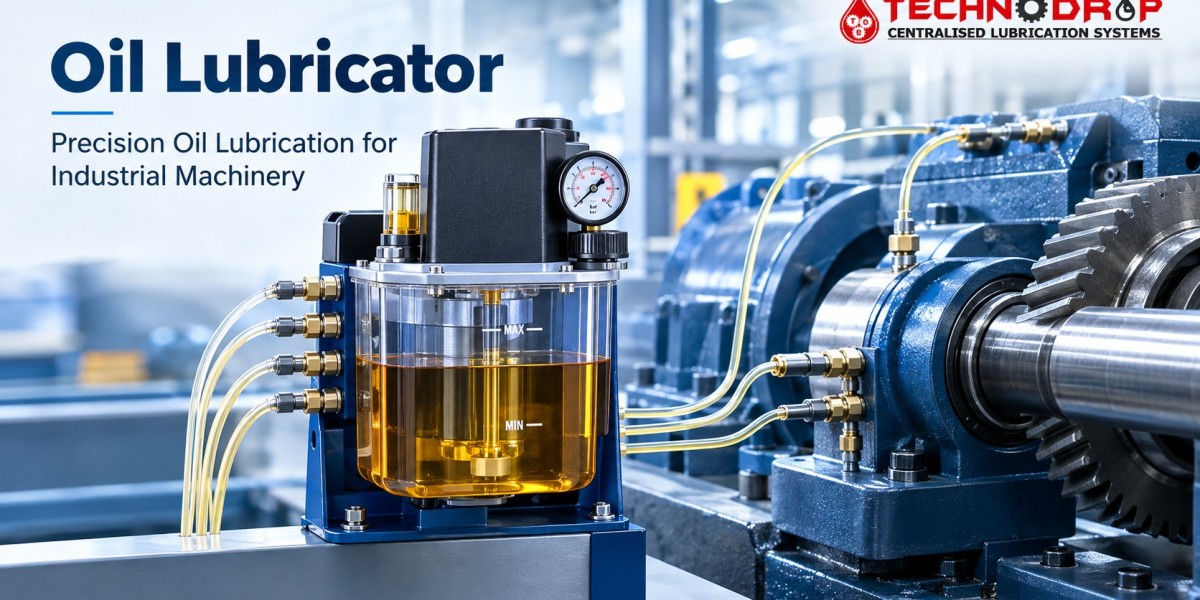

A bearing runs hotter than usual. The operator notices the noise but keeps production moving. By the time maintenance checks the machine, a minor lubrication problem has become a damaged bearing, scored shaft or seized component.
An Oil Lubricator helps prevent that chain of events by supplying oil to friction points in controlled quantities. That control matters: SKF reports that poor lubrication practices and contamination contribute to approximately half of all premature rolling-bearing failures. Applying more oil is not the answer. Applying the correct oil, at the correct point and interval, is.
For plants running crushers, conveyors, rolling mills, turbines or automated machinery, inconsistent manual lubrication is an avoidable production risk.
Oil Lubricator Specifications That Affect Machine Performance
An oil lubricator typically uses a reservoir, pump or pressure source, distribution lines, metering components and control equipment. Depending on its design, it may feed one point or distribute oil across several machine locations.
Published Technodrop specifications cover reservoir capacities from 1 to 50 litres, flow rates from 0.1 to 5 liters per minute and maximum operating pressure up to 250 bar. Actual selection must still be based on the machine—not the largest number in the catalogue.
Manual, Semi-Automatic and Automatic Units
Manual lubricators depend on an operator to initiate delivery. Semi-automatic models reduce some intervention, while automatic units deliver oil according to a timer, machine cycle or controller signal.
Technodrop lists three automation grades—manual, semi-automatic and automatic—and model-dependent operating voltages of 240 V or 415 V. Automatic equipment is normally the strongest choice where missed lubrication intervals can stop an entire production line.
Mounting, Material and Temperature Range
Available mounting arrangements include wall-mounted, tank-mounted and floor-mounted configurations. Construction options include mild steel, stainless steel and aluminum, while the published operating-temperature range extends from −20°C to 80°C.
Here's the detail buyers regularly skip: oil viscosity changes with temperature. A pump that moves oil correctly during a cool trial may deliver differently beside a kiln, furnace or heated process line. Selecting the system without confirming working viscosity is careless engineering.
Five Questions to Ask Oil Lubricator Manufacturers
1. Was the System Selected from Actual Machine Data?
A capable supplier asks for the number of lubrication points, required oil quantity, operating temperature, duty cycle and distance between the reservoir and the furthest point.
A bad answer sounds like: “This standard model works on every machine.” It doesn't.
2. Can Every Lubrication Point Be Metered?
Centralized systems are designed to supply individually metered lubricant to multiple points. Ask how the supplier calculates discharge at each outlet and how the design handles unequal line lengths.
A bad answer is a quotation with only pump pressure and reservoir size. Pressure alone does not prove that the last bearing receives enough oil.
3. How Will Flow Failure Be Detected?
Ask whether the system supports a low-level switch, pressure switch, cycle indication or connection to the machine PLC. Even a single blocked outlet can leave one bearing dry while the pump continues running.
A bad supplier says operators can “check it visually.” That is not monitoring; it is wishful thinking.
4. Are Spares and Drawings Supplied?
Request the piping layout, electrical diagram, recommended oil specification and spare-part list before dispatch.
A bad answer is: “Our technician knows the system.” Your plant should not become dependent on one technician's memory.
5. Is the Quoted Capacity Based on Duty?
Technodrop publishes flow options from 0.1 to 5 liters per minute, but the correct capacity depends on demand and operating frequency.
A bad supplier simply quotes the highest-output pump. Oversizing can increase cost, heat generation, leakage risk and unnecessary oil consumption.
How an Oil Lubricator Protects Production and Maintenance Margins
1. It Reduces Lubrication-Related Bearing Failure
Controlled delivery helps maintain an oil film between moving surfaces. With poor lubrication and contamination linked to roughly 50% of premature bearing failures, this is direct asset protection—not a cosmetic maintenance upgrade.
2. It Prevents Missed Lubrication Intervals
Production pressure regularly pushes manual lubrication down the shift list. An automatic unit follows its set cycle even when maintenance personnel are busy elsewhere.
Nobody tells you how difficult this becomes on machines with hot, moving or guarded lubrication points.
3. It Controls Oil Consumption
Metering components restrict delivery to the required quantity. That reduces waste, oil pooling and housekeeping work while protecting the maintenance budget.
4. It Supports Lubrication During Operation
Many centralized systems can feed oil while machinery is running. This avoids repeated shutdowns for manual access and reduces the risk created by technicians working near moving equipment.
5. It Helps Control Heat and Friction
Oil separates contacting surfaces and carries heat away from loaded components. Technodrop specifies systems for operating temperatures up to 80°C, although the lubricant itself must also suit the real thermal conditions.
6. It Makes Maintenance More Predictable
A central reservoir gives technicians one accessible inspection and refill location. Combined with pressure or level monitoring, it turns lubrication from an irregular manual task into a measurable maintenance process.
Finding Oil Lubricator Suppliers in India
Buying locally is useful only if technical support and spares are genuinely accessible. Oil Lubricator Manufacturers in India should be evaluated on application engineering, component availability and commissioning support—not merely freight cost.
Technodrop operates from Faridabad, Haryana, an industrial location connected to Delhi-NCR and major north Indian manufacturing corridors. That can reduce coordination time for plants in Haryana, Delhi, Rajasthan, Uttar Pradesh and neighboring regions. For distant sites, however, ask who will handle commissioning and breakdown support before releasing the order.
Reliable Oil Lubricator Suppliers in India should also confirm packing, dispatch terms and site responsibilities in writing. “Pan-India supply” does not automatically mean pan-India field service.
Why We Engineer Around the Machine
We have manufactured centralized and automatic lubrication systems since 1999, serving applications across steel, cement, mining, power generation, automation and general manufacturing.
We offer oil lubricators with 1–50-liter reservoirs, manual through automatic controls and multiple mounting configurations. We know that the furthest lubrication point—not the pump nameplate—is often where a weak system design first becomes visible. That is why we need the machine layout and operating data before recommending a configuration.
Send us your machine name, number of lubrication points, required oil grade and viscosity, oil quantity per point, operating temperature, duty cycle, available voltage, mounting space and site location. We will confirm the suitable configuration, price, production lead time, response schedule and MOQ in our quotation. A fixed response time and MOQ are not published on our website, so inventing either would mislead buyers. For faster technical discussion, call or email.
Conclusion
An Oil Lubricator keeps machinery running by delivering controlled oil quantities before friction, heat and wear become breakdowns. The real value lies in correct sizing, metering and fault monitoring—not simply fitting a larger reservoir. Plants that treat lubrication as an engineered process will be better prepared for longer production cycles and tighter maintenance objectives.
FAQs
1. How does an oil lubricator work?
A pump or pressure source conveys the oil from the reservoir via lines and metering devices to the lubrication points to be lubricated. In some models, this delivery may be manual, timed or machine-controlled.
2. Which industries commonly use oil lubricators?
Off these there are steel plants, cement factories, mines, power plants, conveyor installations and automated manufacturing lines. Their suitability is determined by speed load temperature and the lubrication needs of the respective machinery manufacturer.
3. What should I send to Oil Lubricator Manufacturers?
Forward the machine drawing, number of lubrication-points, oil grade, viscosity, required amount, operating frequency, temperature, voltage and pipe lengths. It would be a lot of guesswork without that information.
4. How do I compare Oil Lubricator Manufacturers in India?
Compare cost with accuracy of metering if specified, monitoring features, type of material, pressure rating, drawings, commissioning assistance and spares available. Remember the cheapest may not include controls or installation kits so compare scope on a line by line basis.
5. Can Oil Lubricator Suppliers recommend the oil grade?
They may assist selection, but the lowest usable grade must conform to the manufacturer or bearing supplier as specified. Never trust a lubricator supplier to sidestep an OEM spec.