
Potash occupies a genuinely essential position in global agriculture as a potassium-rich fertilizer salt, and that essential role has only broadened over time. Beyond fertilizer, potash finds use in animal feed supplements, chemical manufacturing, glass production, metallurgy, and water treatment, giving it a demand base that spans agricultural and industrial applications simultaneously. For an investor or corporate adviser evaluating a mining or processing operation, that combination of structurally essential agricultural demand and diversified industrial use gives potash a genuinely resilient market position. The broader shift toward sustainable agriculture adds a further tailwind, as farmers increasingly adopt nutrient management practices, including potash fertilization, specifically to improve crop resilience against climate change.
Understanding the production economics here means starting with mining, since potash is fundamentally an extracted mineral resource rather than a manufactured chemical, and the specific extraction method a given operation uses, underground mining or solution mining, carries genuinely different capital requirements and operating characteristics.
What a Production Cost Report Covers
A proper potash production cost report breaks a mining operation's economics into distinct, individually priced components rather than a single blended figure. It covers the manufacturing process, raw material requirements, utility needs, infrastructure, machinery and technology, manpower, packaging, and transportation, since each responds to genuinely different pressures depending on which extraction method a given operation employs.
Raw materials carry unusual weight in this breakdown relative to a standard manufactured chemical, since the core input is raw potash ore itself, extracted directly from underground deposits. Utilities matter substantially too, given how much energy heating, drying, and crushing potash ore actually requires across the milling and refining stages. Infrastructure and machinery costs cover the specific extraction equipment a chosen mining method demands, tunnel boring machines for underground mining, or brine injection and surface pond infrastructure for solution mining. Manpower, packaging, and transportation round out the picture, and given how much raw ore needs to move from underground or brine sources to surface processing facilities, transportation and material handling logistics represent a genuinely significant, ongoing cost category.
Raw Material Required for Potash Production
The key raw material for potash production is raw potash ore, extracted from underground mineral deposits. This is fundamentally a mined commodity rather than a synthesized chemical, which places potash production economics closer to a mining operation's cost structure, exploration, extraction efficiency, and ore grade, than to a standard chemical manufacturing cost model built around purchased feedstocks.
Because potash deposits are geographically concentrated in specific geological formations, availability of economically viable ore isn't something a plant can simply source from a diversified global commodity market the way it might purchase a standard industrial chemical input. Ore grade and deposit quality directly affect extraction efficiency and the amount of processing required to yield pure, marketable potash, meaning two operations working with different quality deposits can face genuinely different cost structures even when using identical extraction technology. Given global demand growth, both from traditional fertilizer applications and from the broader industrial uses spanning glass, metallurgy, and water treatment, securing access to a genuinely viable, well-characterized potash deposit represents the foundational decision underlying everything else in a potash investment.
The Industrial Production Process
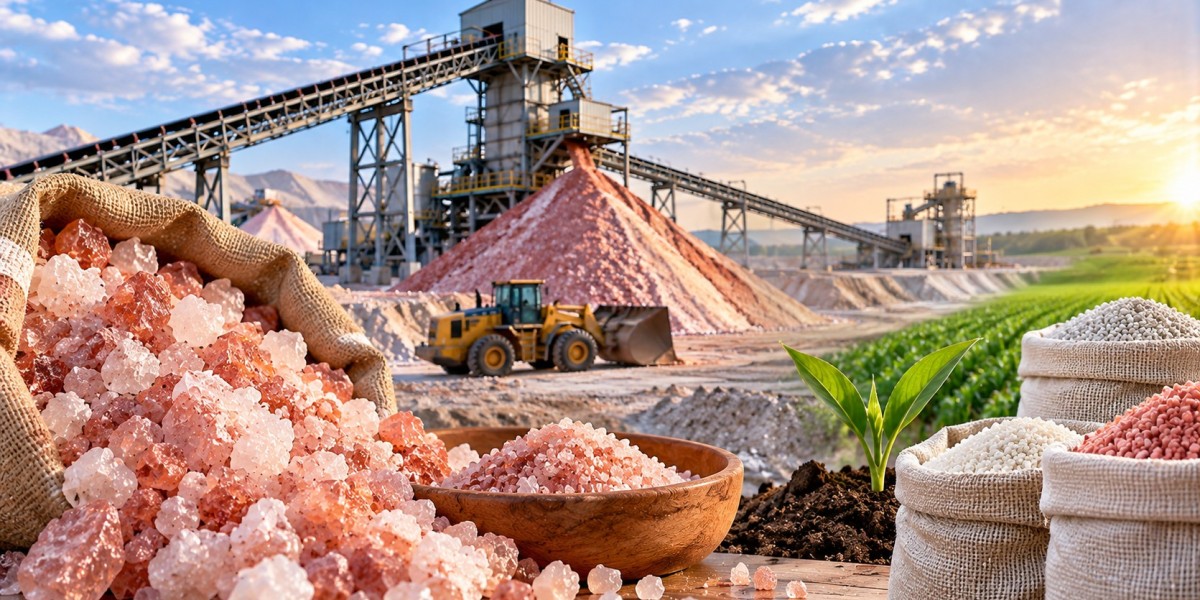
Potash production proceeds through one of two established extraction methods: underground mining or solution mining. Underground mining uses tunnel boring machines to physically dig out raw potash ore from deep underground deposits. The extracted ore then gets transported to a processing mill at ground level, where it undergoes crushing and refining to extract the potassium salts from the raw mineral material.
Solution mining takes a fundamentally different approach. In this process, underground potash ore deposits get injected with heated brine, which dissolves the potassium salts and creates potash-rich brine that gets pumped up to surface ponds. This potash-laden brine then undergoes extraction and milling, followed by flotation and further clarification processes to yield pure, marketable potash. This method avoids the physical excavation that underground mining requires, instead relying on dissolution chemistry to bring the target mineral to the surface in liquid form before separating it out.
Each method carries genuinely different practical trade-offs. Underground mining involves the capital and safety considerations inherent to physical excavation at significant depth, while solution mining depends on effective brine injection and requires substantial surface pond infrastructure for the extraction and evaporation stages that follow. Regardless of which method a given operation uses, the final stages of crushing, refining, and, for solution mining specifically, flotation and clarification, all matter considerably for achieving the purity standards needed for potash's various agricultural and industrial end uses.
Capital Investment and Plant Setup Cost Factors
Capital costs for a potash operation depend heavily on which extraction method gets chosen. Underground mining requires substantial investment in tunnel boring machines and the deep excavation infrastructure needed to safely access underground ore deposits, along with transportation systems to move extracted ore to surface processing facilities. Solution mining instead requires brine injection infrastructure and, notably, extensive surface pond systems needed to manage the potash-rich brine extraction and evaporation process.
Land and site costs carry a distinctive consideration here given how geographically concentrated economically viable potash deposits actually are, a plant's location isn't a flexible choice the way it might be for a manufactured chemical, it's fundamentally constrained by where genuine, well-characterized ore deposits exist. Engineering and construction costs scale with the specific extraction method's infrastructure demands, along with the milling, crushing, refining, and, for solution mining, flotation and clarification equipment needed to bring raw ore or brine to finished, marketable potash. Working capital planning needs to account for the genuinely long-lived, capital-intensive nature of mining infrastructure, a meaningfully different planning horizon than a standard chemical manufacturing operation would face.
Operating Cost Factors
Variable costs are led by the energy charges associated with heating, drying, and crushing potash ore throughout the milling and refining process, alongside labor costs for workers who mine, process, and package the finished potash product. Given how energy-intensive the crushing, drying, and, for solution mining specifically, brine heating stages genuinely are, utility costs represent a substantial and unavoidable part of the overall cost structure.
Fixed costs include maintenance and repair costs for mining and processing equipment, which represent genuinely significant ongoing operational expenses given the demanding physical conditions both underground mining machinery and solution mining brine handling systems operate under. Costs related to waste management, environmental compliance, and safety also contribute meaningfully to overall operating expenditure, reflecting the genuine environmental and worker safety considerations that mining operations, regardless of extraction method, need to manage responsibly throughout their operating life.
Financing costs and depreciation depend on the operation's overall capital intensity, and given how long-lived and substantial mining infrastructure typically is, whether tunnel boring systems for underground mining or brine injection and surface pond networks for solution mining, depreciation schedules here deserve genuinely long-horizon, mining-specific modeling rather than standard chemical manufacturing assumptions.
What Pushes Potash Production Costs Up or Down
Ore deposit quality and accessibility sit clearly at the top of the list, more so than for almost any other factor given how directly deposit grade and depth affect both extraction efficiency and the practical difficulty of accessing the resource in the first place. An operation working with a high-grade, more accessible deposit carries a genuine structural cost advantage over one working with lower-grade or more geologically challenging ore.
Technology and extraction method choice matter too, particularly around how effectively an operation's chosen approach, underground mining or solution mining, matches the specific characteristics of its deposit. Energy costs deserve particular emphasis given how much heating, drying, and crushing potash ore genuinely requires throughout processing, making regional energy pricing a meaningful factor in overall operating economics. Scale plays a real role as well, with larger operations generally achieving better per-unit economics on both equipment utilization and processing efficiency, though potash production's fundamental dependence on specific, geographically fixed deposits means scale opportunities are genuinely constrained by what a given deposit can actually support.
Regional factors round out the picture, and here it's really about which of the world's limited number of economically viable potash-bearing regions an operation has access to, since this single factor arguably matters more than standard regional considerations like general labor costs. Does growing demand from sustainable agriculture practices and diversifying industrial applications change the investment calculus here? Genuinely yes, since both trends support durable, long-term demand growth that favors operations with secure, high-quality deposit access positioning themselves for sustained production over the long run.
Frequently Asked Questions
Q: Why is potash production fundamentally different from a standard chemical manufacturing cost analysis?
A: Because potash is a mined mineral resource rather than a synthesized chemical. Production economics depend on deposit quality, extraction method, and geological accessibility rather than on purchasing and converting a standardized industrial feedstock, placing this cost analysis closer to mining economics than chemical manufacturing.
Q: Is underground mining or solution mining generally the more cost-effective extraction method?
A: It depends genuinely on the specific deposit characteristics. Underground mining suits deposits accessible through physical excavation, while solution mining works well where brine injection can effectively dissolve and extract potassium salts, and the right choice depends on deposit depth, geology, and existing infrastructure more than any universal cost ranking.
Q: How significant is energy cost as a share of total potash production expense?
A: Quite significant, given how much heating, drying, and crushing the ore requires throughout milling and refining. This makes regional energy pricing a meaningful, ongoing factor in overall operating economics regardless of which extraction method a given operation uses.
Q: Does growing demand from sustainable agriculture and industrial applications support long-term potash investment?
A: Genuinely, yes. Both the shift toward climate-resilient crop nutrient management and potash's diversified industrial uses across glass, metallurgy, chemical manufacturing, and water treatment support durable demand growth beyond potash's traditional core fertilizer market alone.
Q: What's the biggest oversight investors make when evaluating a potash operation?
A: Underestimating how fundamentally deposit-constrained this business actually is. Unlike a manufactured chemical where site selection is a flexible cost optimization exercise, potash production is genuinely tied to where viable, well-characterized ore deposits exist, and that constraint deserves to anchor any serious evaluation.
Why This Analysis Matters for Decision-Making
Potash's essential role in global agriculture, reinforced by growing sustainable farming practices and diversified industrial demand across glass, metallurgy, and water treatment, gives it a genuinely durable, structurally supported market position. But its production economics are fundamentally shaped by mineral deposit quality and geographic accessibility, meaning the extraction method and specific site characteristics matter here more than almost any other single factor.
A detailed Potash Production Cost report gives investors, business brokers, corporate advisers, and finance companies the granular clarity needed to properly evaluate a mining operation, rather than treating potash like a standard manufactured commodity when its real economics are governed by mineral deposit access and extraction method. Before capital moves into a deal here, understanding exactly how favorable and accessible a given operation's deposit actually is isn't optional. It's close to the entire foundation of the investment thesis.