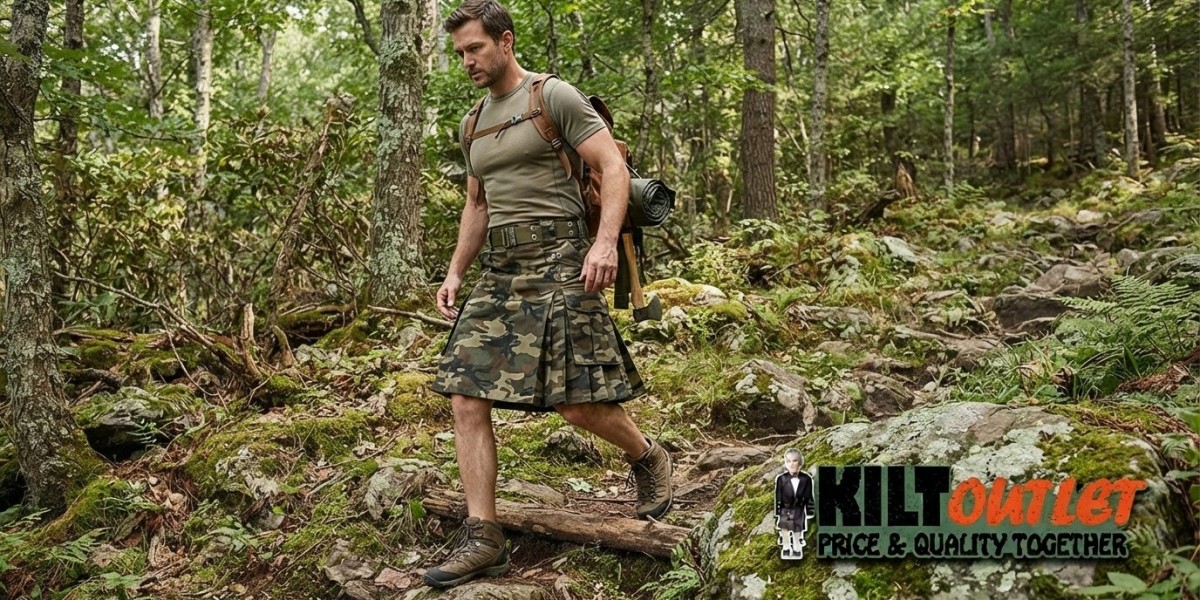

August in the treeline, four hours in, and your pants are soaked from the knee up. You are overheating, the fabric grips every time you crouch, and the seams are chafing raw. Heat management ruins more outdoor days than any other gear failure. A camo kilt fixes the airflow problem while keeping the pattern and pockets you need.
Why Outdoor Users Switch
Air circulates under a kilt instead of sitting trapped against your skin. That single change drops your perceived heat load on long, still summer days.
Movement improves too. No crotch seam means no pulling when you crouch, kneel, straddle a log, or push up a bank.
Drying speed matters after a creek crossing or a rainstorm. A kilt exposes more surface area to moving air, so cotton dries faster on you than trousers do.
The tradeoff is real and worth stating. You lose leg protection against thorns, ticks, and cold wind, which makes a kilt a warm-weather and open-ground choice rather than an all-conditions one.
Match the Pattern to Your Ground
Woodland patterns with heavy green and brown break up well in summer foliage and deciduous cover.
Arid and desert patterns suit open scrub, dry grass, and rocky terrain where green reads as an obvious blob.
Digital and pixel patterns hold their disruption at middle distances. Traditional blotch patterns tend to blend better up close.
Black-based tactical patterns work for range days, airsoft fields, and urban events more than natural terrain, since true black rarely appears in a landscape.
If you only buy one, pick the pattern that matches the ground you spend the most hours on. Trying to cover every terrain with one pattern gets you something mediocre everywhere.
What Separates a Field-Ready Kilt From a Costume Piece
Fabric comes first. Mid-weight cotton canvas or a poly-cotton blend takes brush contact and holds its shape. Thin printed cotton snags and tears on the first real hike.
Pleat construction comes second. The Best Camo kilt options use pleats stitched down through the hip so the folds survive repeated washing and keep their line under a pack belt.
Stitching is third. Look for double stitching at the pocket corners, belt loops, and strap anchors, because those three points carry the load.
Hardware is fourth. Solid brass or stainless snaps and D-rings survive weather. Painted zinc chips within a season and then rusts against the fabric.
Pocket Layout for Field Use
Two deep cargo pockets on the pleats should hold a phone, a compass, gloves, and a snack without swinging.
Flaps with snaps beat open pockets every time. Open pockets empty themselves when you kneel, crawl, or sit on a tailgate.
Side slash pockets keep keys and a knife within reach while you walk.
Check belt loop width before buying. If the loops will not take your usual belt, you end up carrying a second one for no reason.
Sizing Without Guesswork
Measure your natural waist where a belt sits, not your pants size. Pants sizing runs small against a true waist measurement, and that gap causes most bad orders.
Take your hip measurement at the widest point across the seat.
For length, measure from your natural waist to the middle of your knee while standing straight. Field use favors a hem at or just above the kneecap.
Order the larger size if you fall between two. Straps take in a loose waist, and nothing lets out a tight one.
Account for layers. If you plan to wear thermal shorts underneath in shoulder season, factor that into the waist number.
What to Wear With It
Boot socks pulled to mid-calf cut down on tick exposure and brush scratches on the lower leg.
Compression or fitted shorts underneath stop chafing on long days and remove any concern about wind or climbing.
Gaiters work well with a kilt and cover the gap that most people worry about.
Keep the top simple and matched in weight. A light merino or synthetic tee handles sweat better than cotton up top.
Where the Kilt Belongs and Where It Does Not
Warm-weather hiking, camping, fishing, and base camp work all suit it well.
Airsoft, paintball, and range days are popular uses, especially at summer events.
Dense thorn scrub, tick-heavy underbrush, and cold or wet conditions call for trousers. A kilt is a tool for specific conditions, not a replacement for every pair of pants you own.
Deep backcountry travel in unpredictable weather deserves caution. Carry layers if you go that route.
Care That Extends Its Life
Empty the pockets, close every snap, and wash cold on a gentle cycle.
Hang it to dry from the waistband so the pleats fall straight under their own weight.
Skip the dryer. Heat shrinks cotton and sets creases across the pleats that never press out cleanly.
Treat sap, oil, and blood before washing. Hot water sets all three permanently into canvas.
Store it hanging rather than folded. A folded kilt develops a crease through the apron that shows every time you wear it.
Frequently Asked Questions
Does a camo kilt work for hunting?
It works in warm weather and open ground where heat is the main problem. Check your local regulations on required blaze orange before you rely on one during a season.
What do you wear under a camo kilt?
Most outdoor users wear fitted or compression shorts. They prevent chafing over long distances and make climbing and crouching easier.
Are ticks a bigger problem in a kilt?
Exposed lower legs increase contact risk, so pair one with tall socks or gaiters and check yourself after every outing in tick country.
Can you wear a pack belt with a kilt?
Yes. A hip belt sits fine over the waistband, though a heavier belt may flatten the top of the pleats while you wear it.